
Table of Contents
Even perfect stitching cannot save a brand from surprise fees, delays, or damaged freight. The difference between profit and loss often comes down to specific incoterms for clothing. These International Chamber of Commerce rules standardize costs and the critical transfer of risk.
They dictate who pays for logistics, not who ensures quality. I compiled nine essential terms, highlighting every risk transfer point, and a landed cost workflow — all of it part of the wider apparel manufacturing terminology behind a quote — to help you secure your LeelineApparel supply chain.
- Incoterms for Clothing
- 1. FOB (Free On Board)
- 2. EXW (Ex Works)
- 3. DDP (Delivered Duty Paid)
- 4. FCA (Free Carrier)
- 5. CIF (Cost, Insurance & Freight)
- 6. CIP (Carriage and Insurance Paid To)
- 7. CPT (Carriage Paid To)
- 8. DAP (Delivered At Place)
- 9. DPU (Delivered at Place Unloaded)
- 5 Steps to Execute Your Shipping Strategy
- FAQs About Incoterms for Clothing
Incoterms for Clothing
1. FOB (Free On Board)
FOB is the standard for 90% of clothing production. Your supplier handles export clearance and inland trucking. You pay for main carriage, insurance, and import duties. Critically, risk transfers only when goods are loaded on the vessel, not when they arrive at the port (refer to ICC Incoterms 2020 rules).
Real-World Scenario: The Saltwater Trap
A brand shipped tees via EXW and FOB. Both suffered water damage during loading. The EXW insurance claim was rejected because the buyer held risk from the factory door without clear handover proof. The FOB claim succeeded because the supplier remained liable until the Bill of Lading confirmed the goods were “on board.”
⚡ Expert Take: For containerized freight (FCL) from hubs like Thailand or Sri Lanka, FOB leaves a liability gap while goods sit at the terminal. Switch to FCA to transfer risk immediately upon delivery to the carrier.
2. EXW (Ex Works)
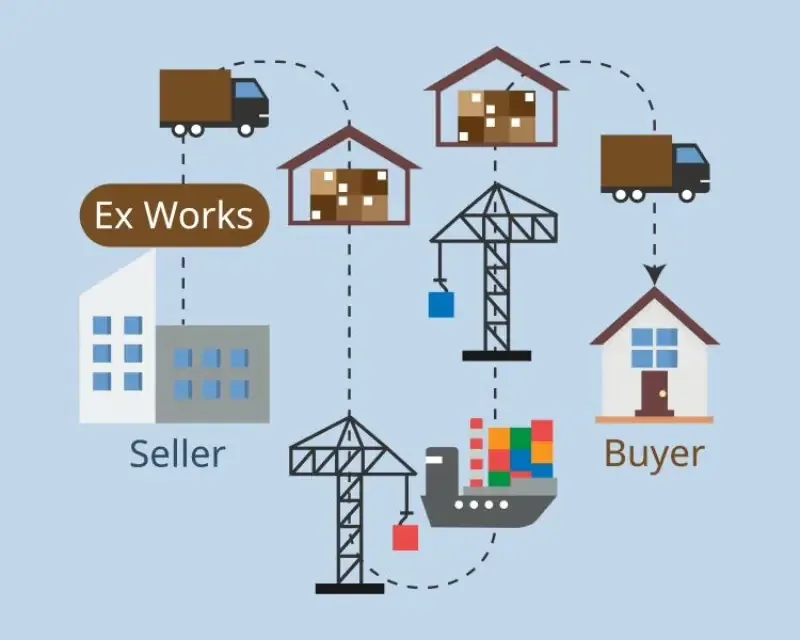
EXW offers the lowest unit price but the highest operational risk. The factory simply makes goods available at their premises. Risk transfers when goods are placed at your disposal—usually on the warehouse floor, not loaded.
This creates three specific nightmares for apparel brands under ICC rules:
- Loading: You are liable for loading. If factory staff help and drop a carton, you pay for the damage.
- Export Clearance: You act as the exporter of record. Without a local license, your goods cannot leave the country.
- Logistics: You manage pickup. If your truck misses the airport cutoff, you pay the penalty fees.
3. DDP (Delivered Duty Paid)
DDP is the “Amazon Prime” of global trade. The seller manages everything: export, shipping, import clearance, duties, and delivery. Risk transfers when goods are placed at the buyer’s disposal at the named destination, ready for unloading (ICC Incoterms 2020).
Startups favor DDP for speed. It bypasses freight forwarders and delivers directly to Amazon FBA.
The Hidden Cost Trap
Simplicity often hides inflated margins. Suppliers may pad duty fees or risk customs penalties by under-declaring values.
- Break It Down: Require a line-item quote separating product, freight, and VAT.
- Audit Paperwork: Demand proof of tax payment to ensure compliance.
Use DDP for samples or small jacket drops. For bulk re-orders, switch to FOB/FCA to control costs.
4. FCA (Free Carrier)
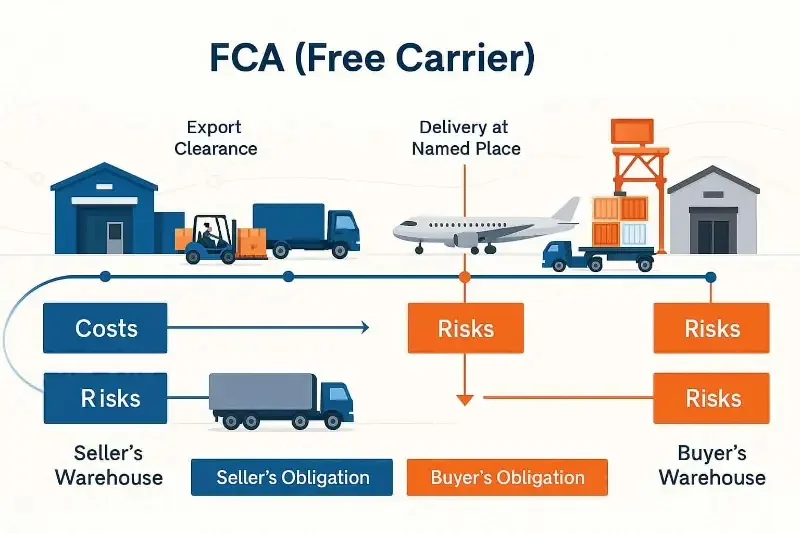
Most brands default to FOB for containers. This is often a mistake. Under official ICC 2020 rules, FCA is the preferred standard for containerized clothing shipments.
The Setup: The seller delivers goods to a carrier you nominate at a named place.
Transfer of Risk: Risk moves to you when goods are delivered to the carrier.
- At factory: Seller loads the goods.
- At terminal/warehouse: Seller delivers ready for unloading.
Why it matters: FOB leaves a dangerous “risk gap” while containers sit at the terminal before vessel loading. FCA transfers risk immediately at handover. This aligns better with modern multimodal transport workflows where goods often sit in holding areas.
Who pays: Seller covers export duties. You pay main freight.
🚀 Actionable Insight: Avoid vague PO language. Write “FCA [Forwarder Warehouse Name], [City]” specifically. If you just list the city, the seller controls the drop-off point.
5. CIF (Cost, Insurance & Freight)
With CIF, the seller pays for ocean freight and insurance to your destination port. But don’t be fooled. Under ICC 2020 rules, risk transfers to you the moment goods are loaded on the vessel at origin. If the ship sinks, it is your problem, not the factory’s.
CIF creates two specific traps for clothing brands:
- The “All-In” Illusion: The price excludes destination Terminal Handling Charges (THC), customs clearance, and final delivery fees.
- Weak Insurance: Factories typically buy minimum “Clause C” coverage. This protects against total loss but often excludes specific textile risks like container rain (mold) or theft.
Use CIF only if you want simplified freight booking but still have the resources to manage import protocols.
6. CIP (Carriage and Insurance Paid To)
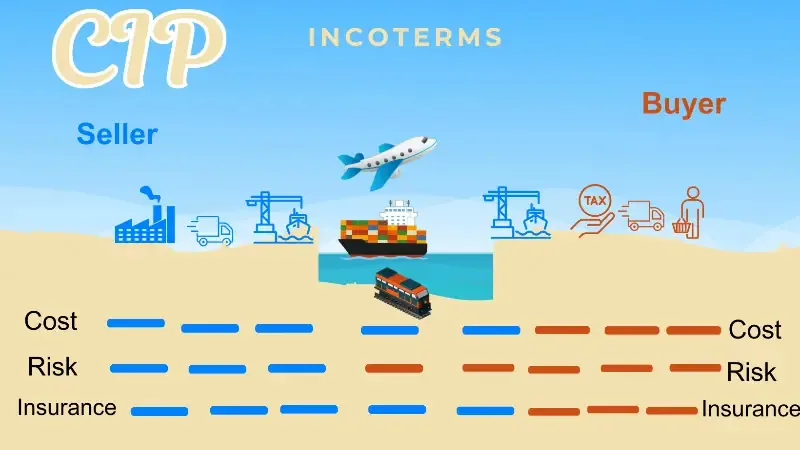
CIP functions like an “insured CPT,” suitable for air, rail, and mixed-mode logistics. The seller arranges transport and pays for insurance to the destination.
The Risk Transfer: Risk shifts to you when goods are handed to the first carrier (often at the factory), not upon arrival.
Why Clothing Brands Use It: Under Incoterms® 2020 rules, CIP mandates Institute Cargo Clauses (A) coverage. This “All-Risk” insurance is superior to CIF’s minimum requirements, protecting high-value garments against theft and water damage during complex air or rail transits. You get the seller’s lower freight rates with maximum cargo protection defined by Lloyd’s Market Association standards.
7. CPT (Carriage Paid To)
Use CPT when you want the factory to book the shipment, but you want full control over import taxes.
The seller pays for transport to a named destination. However, according to ICC rules, risk transfers to you the moment goods are handed to the first carrier. If the container is lost at sea, the financial loss is yours—even though the seller paid the freight.
The Cost Split:
- Seller: Export clearance and main carriage costs.
- Buyer: Insurance, import clearance, duties, and unloading fees.
Apparel Context: Factories often markup DDP tax estimates. CPT allows you to leverage the factory’s volume shipping rates while using your own broker for accurate HTS classification and duty payments.
8. DAP (Delivered At Place)
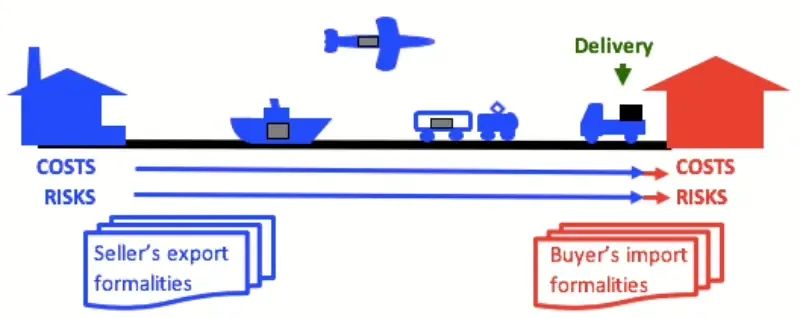
Brands commonly use DAP for sample runs and small air shipments. The seller covers freight to your address, but you must handle import clearance and duties. Risk transfers when goods are placed at your disposal, ready for unloading, per ICC 2020 rules.
The “Real Life” Friction
Expect a notification from the courier (like DHL or FedEx) before delivery. They will demand payment for duties plus a “disbursement fee” ($15–$50) for processing the customs entry. If you don’t pay immediately, your package remains held at the depot.
What to Confirm
- Address Type: Couriers charge extra for residential deliveries. Clarify if you are shipping to a warehouse or home office.
- Fees: Ask who covers the courier’s administrative brokerage fees to avoid disputes.
9. DPU (Delivered at Place Unloaded)
DPU is the only Incoterm that requires the seller to unload the goods. Under official ICC 2020 rules, risk transfers only after the cargo is off the truck and placed at your disposal.
Why It Matters for Apparel
This term safeguards deliveries to 3PLs or small warehouses lacking forklifts. If you ship heavy palletized cartons, DPU forces the supplier to hire the liftgate service or labor to get stock onto the dock.
Who Pays What
- Seller: Transport to destination + unloading costs.
- Buyer: Import clearance, duties, and taxes.
Define the exact drop-off point (e.g., “Warehouse B, Dock 4”). Poor packaging considerations often cause unloading refusals, so specify pallet dimensions to avoid rework fees.
⚡ Power Move: Confirm your warehouse’s receiving window requirements. Under DPU, the seller coordinates the unloading appointment, protecting you from detention fees if the carrier arrives late.
5 Steps to Execute Your Shipping Strategy
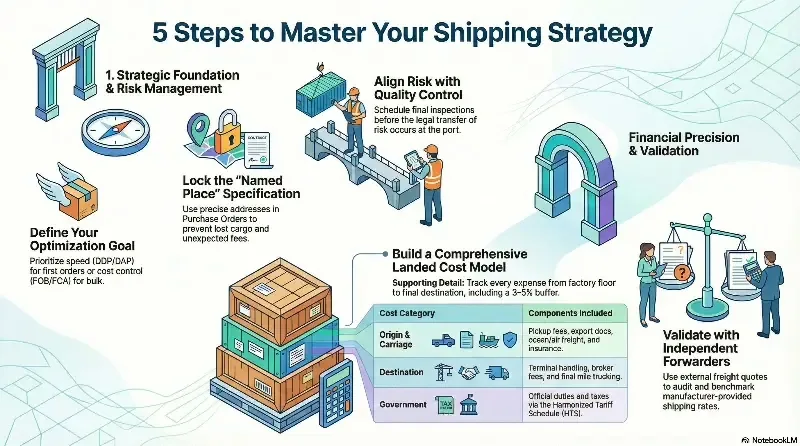
Use this workflow to secure your supply chain and calculate true landed cost. Follow this sequence strictly to prevent disputes and protect your margins.
Step 1: Decide your optimization goal
Choose your priority before you negotiate terms.
- Speed and Simplicity: For your first order, prioritize speed. Select DDP or DAP. This minimizes your liability and simplifies customs paperwork. Do not worry about saving pennies per unit on a test run.
- Cost Control: For repeat bulk orders, prioritize transparency. Select FOB or FCA. This allows you to negotiate your own freight rates and audit every fee.
Step 2: Lock the “named place” as a spec
The “named place” is a critical contract specification. Vague locations lead to lost cargo and unexpected fees. Define the exact address in your Purchase Order. Use these precise formats:
- “FOB Port of Shanghai, China”
- “FCA [Forwarder Warehouse Address], Wuhan”
- “DDP [Your Warehouse Address], New York”
Step 3: Map transfer of risk to quality control
Do not accept legal risk before you verify product quality. Once goods are on the ship, you lose leverage to demand repairs. Action: Schedule a final AQL inspection before the risk transfer event.
- For FOB, inspect at the factory before the container seals.
- For FCA, inspect before the goods leave the factory floor.
Step 4: Build a landed cost model
Do not rely on the supplier’s unit price. Build a cost sheet for every shipment to track the total expense per unit. Include these specific line items:
- Product Cost: The base EXW or FOB price.
- Origin Charges: Pickup fees, export documentation, and terminal handling. Note: Suppliers often hide these costs in EXW quotes.
- Main Carriage: Ocean or air freight plus insurance coverage.
- Destination Charges: Terminal handling charges, broker fees, and final trucking.
- Duties & Taxes: Calculate this using the official Harmonized Tariff Schedule (HTS).
- Buffer: Add a 3–5% buffer to cover unexpected accessorials.
Step 5: Use a freight forwarder for validation
Treat a forwarder quote as a benchmark, not a last resort. Manufacturers often add hidden markups to shipping rates. Action: Request a quote from an independent freight forwarder. Compare this “apples-to-apples” against your supplier’s DDP price. Demand an itemized list of fees. If the supplier refuses to itemize, they are likely inflating costs.
Need help validating the right term? Contact LeelineApparel for a clear cost breakdown. Visit LeelineApparel to explore our complete supply chain solutions.
FAQs About Incoterms for Clothing
1. FOB vs CIF for clothing brands—what’s better?
FOB (Free On Board) is usually the better choice for brands that want to control their margins. It allows you to select your own freight forwarder and negotiate better shipping rates.
With CIF (Cost, Insurance & Freight), the supplier selects the carrier and often purchases the minimum required insurance, leaving you exposed to specific risks. Note that under ICC rules, both terms transfer risk to you once the goods are loaded on the vessel.
2. What’s the best Incoterm for a clothing startup importing for the first time?
DDP (Delivered Duty Paid) is the safest starting point. It functions like a standard e-commerce delivery where the supplier handles all logistics, customs, and duties. This lets you focus on sales rather than complex import paperwork. If you have a trusted customs broker, DAP (Delivered At Place) is a viable alternative that keeps duty payments in your control.
3. How do I calculate landed cost for fashion?
Never use the factory’s EXW or FOB price as your final cost. You must calculate the total expense to get the product to your door.
Use this formula: Landed Cost = Product Cost + Ocean/Air Freight + Insurance + Customs Duties + Local Trucking. Always verify your duty rates using the official Harmonized Tariff Schedule before setting your retail prices.
