Theatre & Procedure
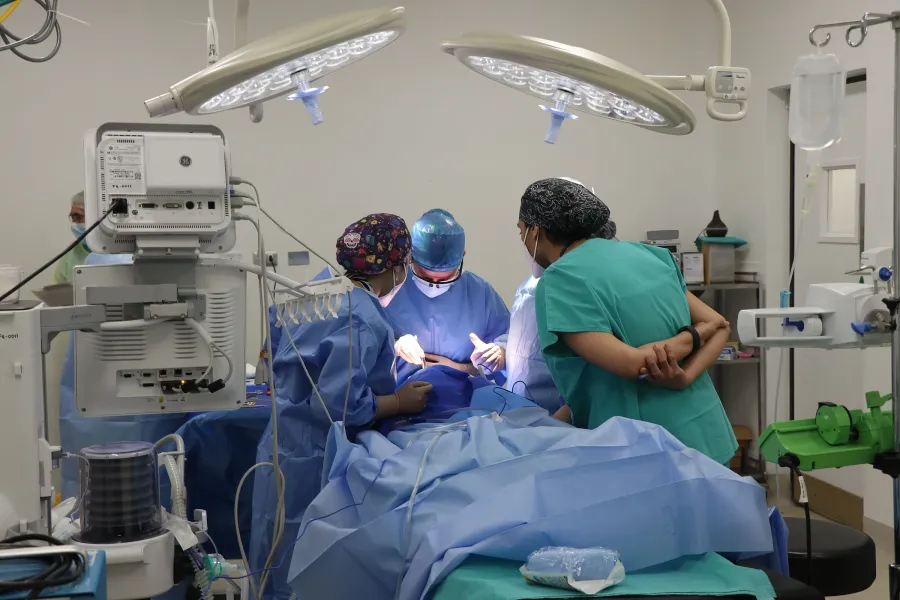
Surgeons, theatre nurses, anaesthetic and recovery staff.
Long sterile-adjacent shifts, frequent change, hospital laundry rather than home.
- Scrub tunic
- Scrub trouser
- Warm-up jacket
Laundry Hospital laundry, changed daily
Send the department list, roster split and laundry clause. You get a sealed shade card per zone, a size matrix cut from your headcount — 2XS to 5XL with short to long inside leg — and a test report run to the regime your contract names. Badges and chest marks are approved on a physical sample that has been through your thermal cycle.
Department Zoning
A hospital does not wear one uniform. It wears a colour system, and a colour system is only a system if the shade survives the laundry route its department uses. The zones below pair the people, the exposure and the wash regime.
Surgeons, theatre nurses, anaesthetic and recovery staff.
Long sterile-adjacent shifts, frequent change, hospital laundry rather than home.
Laundry Hospital laundry, changed daily

Ward nurses, healthcare assistants, ward managers.
Twelve-hour shifts, repeated bending and lifting, ink and fluids.
Laundry Hot cycle; colour fastness is the constraint
Clinicians, phlebotomists, lab technicians, imaging staff.
Direct skin contact for a full day; low-lint and non-shedding where samples are handled.
Laundry Frequent warm wash; fabric must stay soft
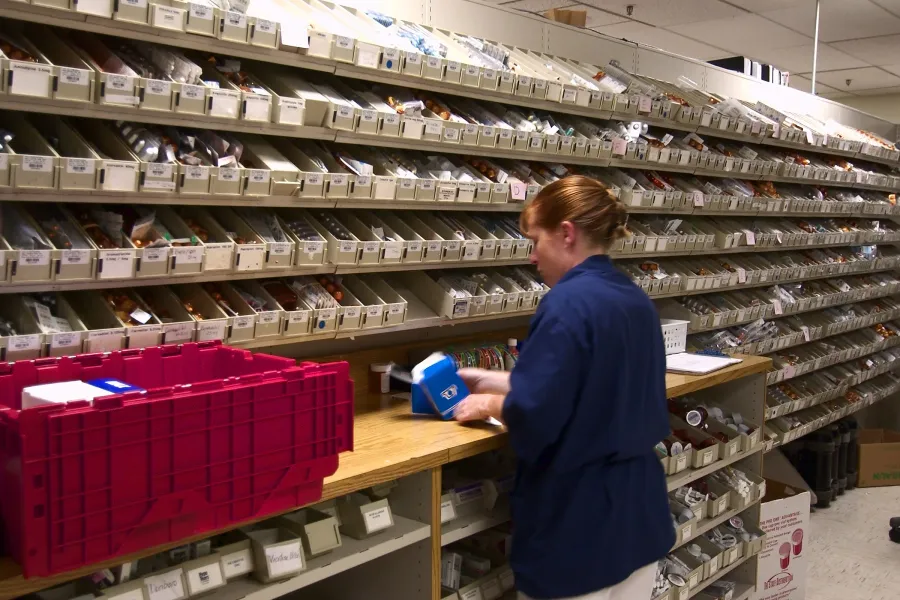
Pharmacists, dispensary and stores staff.
Long spells standing, lifting stock, a tidy line seen by patients.
Laundry Moderate wash, shape retention matters
Porters, cleaning and estates teams, catering.
Highest abrasion, heaviest stains, shortest garment life if the fabric is chosen for looks.
Laundry Industry laundry; abrasion and shrinkage decide the fabric
Reception, patient liaison, administrative staff.
The face of the building; sits at a desk but is seen by all who walk in.
Laundry Domestic wash; appearance and fit lead
The Roster Is the Size Chart
A retail buyer sizes to the curve that sells. A clinical programme sizes to the curve that turns up for a shift — a workforce that runs wide at both ends, spans a much bigger height range than a fashion line, and changes shape across departments.
| Band | Where it is carried | Length options | Share of a mixed roster |
|---|---|---|---|
| 2XS – XS | Carried for student and junior cohorts; often ordered separately rather than split out of a standard run. | Short inside leg option | |
| S – M | The bulk of outpatient, lab and admin posts. The band a clinic chain runs deepest on. | Short / regular | |
| L – XL | Ward and portering posts, where the widest part of a roster sits. | Regular / long | |
| 2XL – 3XL | A real share of any clinical workforce. Priced and graded as a standard band, not a special order. | Regular / long | |
| 4XL – 5XL | Issued on demand against the approved matrix; kept in the reorder path so a replacement is a single line. | Long | |
| Length, all bands | Tall and petite staff are covered by an inside-leg choice within the band, not by moving up a size. | Short · regular · long |
Send the roster split by zone and role, not a single overall number. The split is what sets the depth per band.
A representative panel tries the sample in its band, including tall and petite, before the size run is locked.
The approved size matrix is retained. A replacement hire is issued against it, with no second measuring round.
The Wash Clause
Most uniform quotes compare a unit price against a swatch. A healthcare procurement has to answer a different question: after the cycle count written into the contract, is this still the same garment — the same shade, the same size, free of pills and burst seams?
Before the Quote
Headcount split by department and role is all the sizing pass needs. It comes back as a coverage map — six bands, short to long inside leg — priced as standard positions, with the extended bands kept in the reorder path.
Drawing the Line
Infection prevention is the most important thing a healthcare uniform touches — which is exactly why the language around it has to be exact. Here is where the sales claim and the standard usually part company.
One Shift, Six Checkpoints
Nothing in a scrub set is decided at the point of purchase. It is decided at 07:00 in a handover, at 10:00 over a bed, at 14:00 lifting a patient, at 19:00 walking out still looking like the same professional who walked in.
Handover — standing, reaching across a desk, taking a report.
A neckline that gaps when the wearer leans forward; a hem that rides up when walking in.
Neckline depth and curve calibrated for forward lean; trouser rise set so the waistband stays put under a tunic.
Bedside rounds — repeated bending, squatting, reaching to a low drawer.
A back that pulls out of the trouser; a sleeve that pulls across the shoulder when reaching.
Action-back pleat or stretch panel; sleeve head cut for a raised arm rather than a T-pose.
A full day of pocket use — notes, pens, a phone, alcohol gel.
Pockets that sag, tear at the mouth, or pull the front of the garment out of line.
Reinforced pocket mouth; pocket bags sized to the load and bar-tacked at the stress point.
Lifting and transferring — a two-person move, arms forward and up.
A side seam that gives way, a crotch seam under tension, a fabric with barely any give.
Four-way stretch or a gusseted seam where it is loaded; stretch allowance graded by size, not flagged as an extra.
A ten-hour mark — the fabric has absorbed a shift of movement and moisture.
A blended fabric that clings, creases hard, or shows sweat at the back and underarm.
Moisture-managing blend and a weight that holds shape without stiffness; pilling checked after repeated wash.
Handover out — walking a corridor, still in view of patients and families.
A garment that has visibly aged by the end of the shift and reads as untidy.
Colour and shape retention specified to the wash regime, so the 19:00 impression matches the 07:00 one.
Ward-Level Replenishment
The unit of a medical uniform order is not a season and not a range. It is a department, a size split and a date. Wholesale scrub uniform suppliers are kept or dropped on how cleanly they can repeat that small, frequent order without the shade drifting or the sizes running short.
One clinician leaves and one arrives. The matrix already holds the size — the order is a single line in an existing colour.
Issued from the approved size matrix, matched to the sealed shade card, with no re-measuring round.
A cohort of students or new starters joins at once and needs sets before induction week.
Cut against the size split you send, from continuity fabric, on the reorder lead time rather than a fresh development cycle.
A set of garments reaches its contracted cycle count and is withdrawn from service together.
Replaced to the same spec and shade, sized to the current roster, so the ward stays visually uniform through the swap.
A service line opens and joins the programme with its own zone colour and garment mix.
Added to the existing programme under a new zone reference, with the spec pack extended rather than restarted.
Programme Experience
Two buyers describing the same three things a medical uniform programme is judged on: whether the wash clause held, whether the size matrix removed the fit complaints, and whether a replacement hire stopped being an event.
Department blue was piloted against the trust's own laundry clause — 71 °C for three minutes, then the full cycle count. At cycle 80 the grey-scale reading still sat inside tolerance.
Roster fit ran wider at both ends than head office assumed: six bands, short through long inside leg. Fit complaints at intake fell to zero in the first quarter.
A rival quoted an antimicrobial benefit the committee could not evidence. The tender file stopped at workwear and said so plainly, and that honesty won it.
Across 14 sites the first order held on a domestic-wash contract at 60 °C — scrub tops, trousers, tunics, all 100 units a colour. Fabric, trims and shade were proven in one run.
A leaver and a starter are now one line on the approved matrix. Reorder-to-ward sits at 18 days, against the six weeks a fresh purchase order used to take.
Adding the new outpatients suite took a single reference, not a second launch: same spec pack, on the standard 15–25 working-day cycle.
Procurement Questions
The tender deadline, the barrier claim, the shade that has to match across campuses, the nurse a standard size run does not fit, and the scrub set that shrank by the twentieth wash.
A standard RFQ comes back within 24 hours, and a sample set off the approved spec is cut in 5–7 days. Wash-test reports are then run to the method and the regime your clause names — colour hold, shrinkage, pilling — and sent with the fabric and construction spec behind them.
Where the calendar is tighter than the lab’s own turnaround, the date is flagged at quoting rather than after the deadline. The file is assembled for a committee: fibre content, OEKO-TEX Standard 100 Class II record for the base cloth, a shade reference per department, and the inspection standard applied before shipment. Certificate numbers and validity dates follow on request to qualified buyers.
No — routine scrubs are workwear, and the spec pack says so. Fluid-resistant gowns and aprons worn over them are what provide the barrier, which is the same position the UK NHS takes. EN 13795 governs surgical gowns and drapes, not scrub tunics or trousers; ANSI/AAMI PB70 levels apply only to gowns carrying a liquid-barrier claim.
Where a healthcare uniform programme needs a barrier item, it is specified as a separate product against the relevant standard. Infection-control teams tend to respect that line more than a supplier who blurs it.
No infection-reduction claim is made here, and a buyer should check hard on any supplier who makes one. In the United States, a claim that a garment kills or reduces germs is a public-health claim requiring EPA registration; in the EU the active substance falls under the biocidal regulation, with skin-contact textiles a restricted use.
Trials of silver-coated scrubs have not shown a reliable difference against untreated scrubs across a real shift. What a tender can audit is whether the garment survives the wash regime that actually prevents cross-contamination — and that is where the spec effort goes.
Each department gets one sealed shade card at sampling, held on file, and every reorder is matched against it before cutting. A new campus draws the same reference rather than commissioning a fresh approval, which is what stops a trust ending up with two greens in year two.
Colour is specified with a tolerance and assessed to ISO 105 grey scale, not to someone’s eye on a monitor. Where a group already runs colour standards, the card is built to match them so the new healthcare uniform run issues into the existing system.
The matrix is built from your roster, not a retail curve. Headcount comes in split by department and role; the coverage map returns across six bands from 2XS to 5XL, with short, regular and long inside-leg options inside each band, so height is solved by a length choice rather than by sizing up.
The extended bands are priced and graded as standard positions, kept in the reorder path, and tried on a representative staff panel before the run is locked. Shoulder width and rise differ far more across a clinical workforce than across a fashion line — the matrix is where that shows up.
Shrinkage and surface wear are treated as acceptance fields, not afterthoughts. Dimensional change is assessed to ISO 5077 / ISO 6330 and pilling to ISO 12945-2, run to the cycle count your laundry contract names rather than a domestic wash.
Before bulk approval, the sample set goes through the regime itself, and the report goes into the tender file. Fabric is chosen for thermal washing rather than showroom hand, and the seam and pocket mouths — where wear starts — are bar-tacked at the stress points.
Decoration is specified to the fabric and to the wash regime, then approved on a physical sample before cutting. A chest logo, department mark or role indicator is placed where the garment sits once worn, so a tunic that shifts under a fleece underlayer does not drag the mark out of position.
Thermal disinfection cycles are the usual cause of lifting, so the decoration route is chosen against that temperature rather than a domestic wash. Marking is the last thing set — after fit, zone colour and fabric are agreed — and it is recorded in the spec pack with the rest of the approval.
The minimum is 100 units per design per colour. Mixing sizes within a design counts toward the total; splitting across designs or colours does not. One intake on its own usually falls short, but the same approved spec covers the department’s full roster, leavers and every later intake, so the first order is normally shaped around the whole zone.
The sensible opening is a ward pilot: one department, one garment set, one colour, enough units to run the wash trial honestly before the estate commits. Sampling runs 5–7 days and standard production 15–25 working days from approval.
One, and that is the point of a zoned programme. The scrub tunic and trouser, the warm-up jacket or fleece underlayer and the lab coat are cut to the same sealed shade card and sized to sit over one another, so a theatre set and an outpatient set read as the same system rather than a near-miss.
Layered garments share the fabric lot and shade reference, travel in one spec pack and follow the same reorder path. A replacement underlayer and a replacement scrub set arrive against the same approval instead of two separate supplier conversations.
Send the regime your laundry contract actually runs — temperature, cycle count, colour tolerance. We will cut a sample set against it and send the result, so the decision rests on the garment rather than the promise.
Start typing to find articles
No articles found
Try a different keyword