Neutral Labels · Mixed Cartons · One Consolidation

Wholesale Clothing Supplier,

Reorders Held to Spec.

A wholesale apparel supplier for distributors is judged on what arrives, not on what is quoted: a mixed-carton order that groups several styles into one shipment, carries no competing brand when it reaches the distributor’s accounts, and comes back identical on the third reorder. Orders begin at 100 units per design per colour and consolidate beyond that.

300+ brands served
35,000 units / month
98% on-time delivery
24h RFQ response

Where the Line Sits

A Production Partner, Not a Stocking Warehouse.

Searching for a wholesale apparel supplier for distributors returns two very different businesses: one holds blank stock sold by the carton, the other builds the garment to a specification and ships it under a label chosen by the buyer. This page is the second.

What the program covers
  • Made to a Specification

    Pattern, fabric, fit and finish are set from a brief — a sketch, a reference garment or a tech pack. Nothing is picked off a shared catalogue.

  • A Label, or None at All

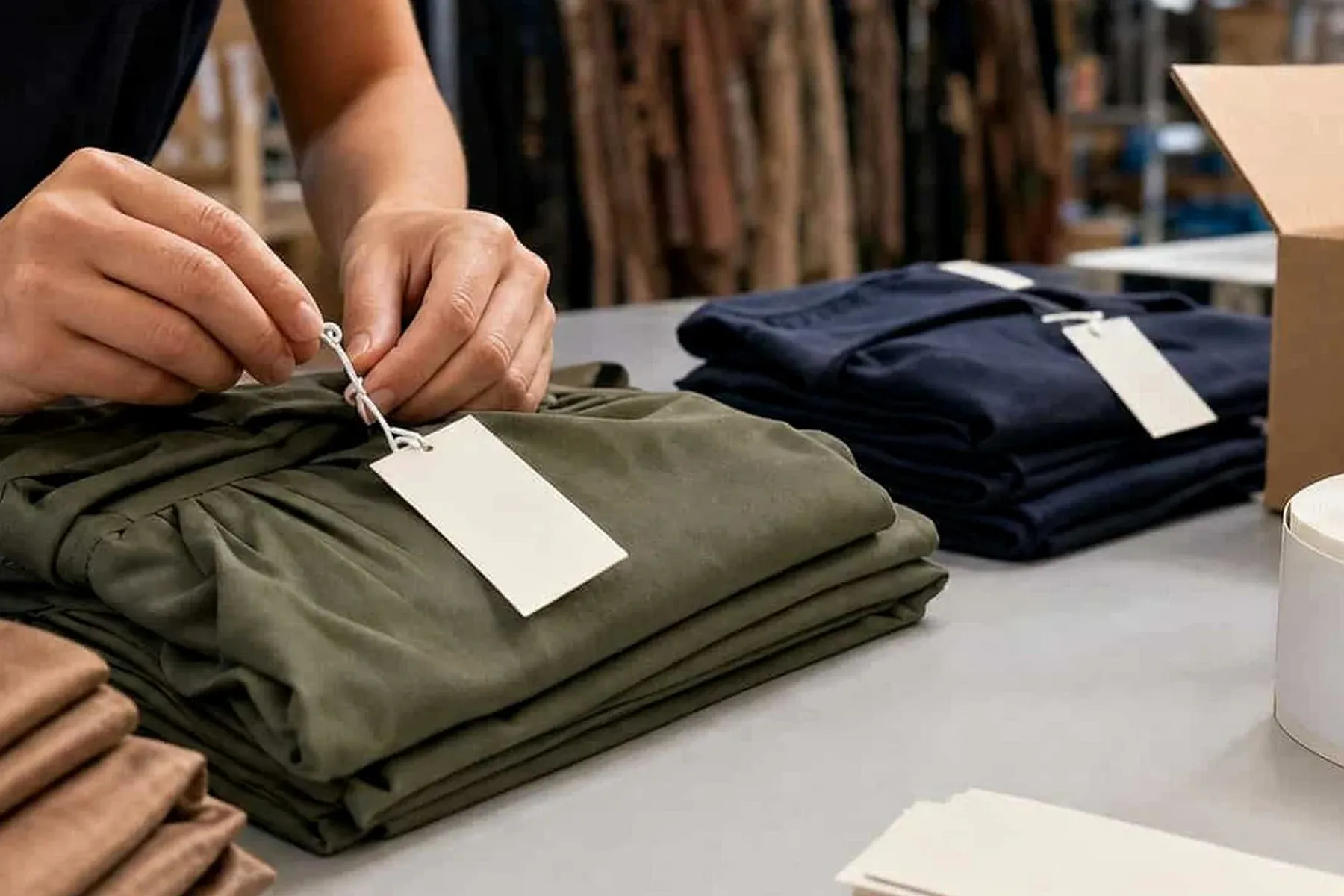
    Neutral labelling for house-brand lines, or a woven label, hangtag and care content when the line carries the buyer’s name.

  • Mixed-Carton Consolidation

    Several styles grouped into one shipment, 100 units per design per colour. Cartons are marked and listed per destination.

  • Specs Retained Between Orders

    Approved fabric, shade, pattern and label data stay on file, so a restock is quoted against the original record rather than starting again.

What stays with the distributor
  • Stock and Immediate Dispatch

    There is no finished-goods inventory to draw from. Goods are cut after approval, so the first shipment runs on a production calendar.

  • Warehousing and Pick-and-Pack

    Goods ship to the distributor’s warehouse or a named 3PL. Storage, shelf allocation and single-unit picking stay on the buyer’s side of the line.

  • Resale Pricing and Territory

    The factory does not sell direct, set retail prices or assign territories. The customer relationship and the margin belong to the distributor.

  • Blank-Decoration-Only Runs

    Printing or embroidery applied to a blank already owned by the buyer is not a settled offer — it is confirmed per project before quoting.

The Label Ladder

How Much of the Brand Travels With the Garment.

A style in a distribution catalogue can sit at one of three points on the same ladder. The decision is not garment quality — it is how much of the reseller’s identity is stitched into the product before it reaches the shelf.

Neutral

House-brand lines, overstock relief and styles sold on as a component rather than as a branded product.

On the garment
  • Statutory care and composition label
  • Size label
  • Country-of-origin mark
  • No brand mark anywhere
What the customer sees

A finished garment with no maker identity — the only name on the shelf belongs to the distributor.

Watch for

Nothing attaches the garment to a supplier, so a buyer comparing lots has only the retained spec record to fall back on.

House Label

Own-label ranges and multi-brand catalogues where the label is the distribution business rather than a single consumer brand.

On the garment
  • Woven or printed neck label in the reseller’s name
  • Hangtag with the house mark
  • Statutory care and composition content
  • Consistent label placement across styles
What the customer sees

A name at the neckline and on the tag, in a position that does not move between styles.

Watch for

A house label applied to several unrelated products only holds up if placement and label type are locked in the spec.

Full Private Label

Brand programmes sold under a dedicated label, where the garment has to stand on its own against retail competitors.

On the garment
  • Custom woven or damask neck label
  • Branded hangtag and size tag
  • Custom care label carrying the brand’s content
  • Polybag, sticker or box in the same run
What the customer sees

A retail-finished garment with one identity running neckline, tag and carton.

Watch for

The whole package has to be approved together; a tag approved after the labels are cut is the usual source of a mismatched first lot.

Non-negotiable

Within all three levels: fibre composition, care instructions, size and country of origin stay on the garment. Neutral does not mean unlabelled — a garment that arrives without statutory content cannot be lawfully sold in any market the programme serves.

Mixed-Carton Consolidation

Several Styles, One Shipment.

A distributor rarely ships one style. The order is a catalogue slice — a few hundred of this, a few hundred of that — and it only makes commercial sense as one consolidated shipment, marked per destination.

Consolidation build 5 styles · 14 cartons · 2 destinations
ST-01 Heavyweight tee 400 units 4 cartons DC A
ST-02 Fleece hoodie 300 units 5 cartons DC A
ST-03 Woven overshirt 200 units 2 cartons DC A
ST-04 Jogger 250 units 2 cartons DC B
ST-05 Sweat short 150 units 1 carton DC B
DC A DC B

Illustrative consolidation — one carton mark per destination, not per style.

01

The size ratio, per style

A size split is agreed per style before cutting. A consolidated shipment keeps those ratios separate instead of averaging the catalogue into one run.

Prevents

A style arriving in a size mix nobody ordered, because the split was pooled across the order.

02

The carton mark, per destination

Cartons are marked by the address they are going to, not the style inside them. A shipment covering two warehouses arrives as two identifiable sets.

Prevents

Cartons re-sorted by hand at the warehouse because the outer mark named the style and not the destination.

03

The packing list, per carton

A carton carries its own list — style, colour, size and quantity. A short shipment is traced to the carton rather than argued over at invoice.

Prevents

A discrepancy that cannot be located, so it is either absorbed or disputed with no record.

04

The LCL and FCL threshold

Small consolidations move as shared-container freight; at full-container volume the same order ships intact. The quote names which one the volume lands in.

Prevents

Being quoted one freight basis and invoiced on another when the volume shifts.

The Quantity Ladder

What Actually Changes as Volume Rises.

A distributor comparing quotes on unit price alone is comparing the wrong number. What moves between a first order and a recurring programme is the production basis — and that is what the tiered quote reflects.

100 – 299 units

Entry run

A new category tested in the catalogue, or a single style before a season is committed.

What changes
  • Per-design minimum, per colour
  • Sampling and grading charged as a development step
  • Fabric bought to the order

The basis that lets a category enter a catalogue without a full-container bet.

300 – 499 units

Range build

A small range launched together, with the size curve and shades set across styles.

What changes
  • Several styles cut on one production plan
  • Fabric sourced for the whole range, not per style
  • Decoration batched across styles

Where a catalogue slice starts to behave like one order instead of several.

500 – 999 units

Programme volume

A recurring line replenished on a cycle, with continuity fabric held between orders.

What changes
  • Tiered pricing applies
  • Continuity fabric held for restocks
  • Replenishment quoted against the approved spec

The point where a restock is priced as a repeat rather than a new order.

1,000+ units

Container scale

A full season or a multi-category programme shipped on a container schedule.

What changes
  • Tiered pricing applies
  • Production slots planned across the season
  • Full-container consolidation per destination

Volume is planned on a calendar rather than ordered per style, so peaks are booked ahead.

Before the Season Locks

Send the Catalogue List, Get It Priced Together.

A list of styles, a rough quantity against a selection and a destination is enough to build a consolidation quote — which style lands in which carton, the tiered price basis, and the landed figure per destination.

Where the Goods Finally Sell

The Channel Sets the Requirement.

The same hoodie is a different product depending on whether it sells on a marketplace, to a boutique, under a corporate logo or on a team. The channel decides the packing, the label and what a return looks like.

Sealed polybags with barcodes applied for a marketplace listing
Marketplace & own e-commerce

Online Retail and Marketplaces

What the channel demands

Unit-level barcodes, a sealed polybag per garment, a size label a customer can read through the bag, and a parcel that survives a courier network.

Where it fails

A polybag without a barcode forces relabelling before goods can be listed — the shipment lands but cannot go on sale. Missing barcodes force relabelling before goods can be listed — the shipment lands but cannot go on sale.

Program response

Packing specified per unit with the barcode applied on the line and a box that meets the carrier’s own limits, so the carton can be booked in on arrival.

Cartons split and labelled per wholesale account
Multi-brand wholesale

Wholesale Accounts and Boutiques

What the channel demands

A hangtag the boutique’s customer will read, a size ratio that matches how the account sells, and packing separated by account.

Where it fails

One pooled carton for several accounts means the boutique owner sorts the order by hand before it reaches the rail. A pooled carton makes the boutique owner sort the order by hand before it reaches the rail.

Program response

Packing split and marked per account, with the size ratio agreed by account rather than averaged across the order.

Branded corporate gift box with a decorated garment inside
Corporate & promotional

Corporate Gifting and Promotional Programs

What the channel demands

A client logo placed to an approved position, a delivery date tied to a campaign, and presentation that suits a recipient rather than a shop.

Where it fails

A logo that lifts after the first wash turns a branded gift into a complaint aimed at the distributor. A logo that lifts after the first wash turns the gift into a complaint aimed at the distributor.

Program response

Decoration approved on a physical sample against the actual fabric, with the decoration method named in the spec so a reorder repeats it.

Team kit packed by squad with a roster list inside the carton
Uniform & team resale

Uniform and Team-Sport Resale

What the channel demands

Durable constructions, a size range that reaches the ends of a squad, and a restock path for late joiners and replacements.

Where it fails

A squad kit ordered once, with no replacement path, strands the account when the season starts and three players arrive. A kit ordered once, with no replacement path, strands the account when late players arrive.

Program response

A size matrix held on file and a continuity lot behind it, so a replacement draws on the original run instead of a new minimum order.

Store-ready folded garments in cartons marked by destination store
Bricks-and-mortar chains

Physical Retail Chains

What the channel demands

Folding that presents straight to shelf, consistent shade across stores, and a carton marked by store rather than by style.

Where it fails

Cartons pooled by style force the DC to break and re-sort boxes before store allocation. Cartons pooled by style force the DC to re-sort every box before store allocation.

Program response

Cartons marked and packed by destination store, with shade checked against the sealed standard before the goods leave the floor.

Capacity & Calendar

A Season Is Booked, Not Summoned.

A distributor cannot resell a promise of capacity. What makes a reorder safe is a production calendar planned against the same lines, the same floor and the same technician team that cut the first order.

7 production lines Dedicated lines, not brokered capacity — the order stays on one floor.
35,000 units per month Monthly output on the current floor.
420,000 units per year A full-year ceiling a season is planned inside.
98% on-time delivery The figure a container schedule is measured against.
Sewing lines running across a garment factory floor
Illustrative load calendar Peaks booked one season ahead
  1. Jan
  2. Feb
  3. Mar Spring programme
  4. Apr
  5. May
  6. Jun
  7. Jul Autumn booking opens
  8. Aug
  9. Sep Peak
  10. Oct
  11. Nov
  12. Dec

Slots are held, not queued

A recurring programme books its production window when the season is agreed, so a restock lands in a reserved slot instead of waiting behind new orders.

Heavy goods need the longer calendar

Quilting, towelling, outerwear and denim run 30–45 working days against 15–25 for standard cut-and-sew. Those lines are scheduled first, because they set the container date.

A held fabric becomes continuity

Fabric bought for a programme is retained between orders, so the second run draws on an existing lot rather than a new mill booking.

The Document Pack

Every Box Arrives With Its Paperwork.

A distributor is accountable for what it imports and resells. The paperwork is not an add-on requested after the shipment — it is prepared alongside the order and travels with the carton mark.

01

Fibre content and care instructions

Composition by percentage, care symbols and wash instructions, in the wording the destination market accepts.

Asked for by Required on a garment offered at retail in the US, UK and EU.
02

Country-of-origin marking

The origin mark on the garment and the matching declaration on the commercial documents.

Asked for by Customs entry at the destination market.
03

Packing list, per carton

Carton count, style, colour, size and quantity for the box that carries it, plus the destination mark.

Asked for by Warehouse receiving and any shortage claim.
04

Commercial invoice and HS classification

The invoice basis for the shipment and the classification the goods are declared under.

Asked for by Customs clearance and duty assessment.
05

Test and certification records

Fabric and trim test documentation relevant to the order, with the certificate set available to buyers who need it for their own compliance file.

Asked for by Retail onboarding and buyer compliance review.
06

Approved spec pack

The sealed shade standard, approved fabric and trims, decoration placement, size matrix and label artwork — held by both sides.

Asked for by A reorder, or a new buyer inheriting the account.

Client Experience

What Changes After the First Consolidation.

Two wholesale businesses, two different catalogues — a house-label distributor running four seasons, and a multi-label wholesaler shipping three brands at once.

We ran a house-label range through four factories before this, and the neutral-label styles never matched between lots. One sealed shade standard and a retained spec record ended that — the second season came back on the same base cloth without resampling.

Consolidation was the real change. Six styles, one destination, fourteen marked cartons. Our DC stopped breaking and re-sorting pallets, which took about a day and a half out of receiving.

A distributor’s margin lives in the landed number, so the whole journey gets quoted now. The first season saw unit prices compared and money lost on final mile.

Ingrid Halvorsen

Ingrid Halvorsen

Sourcing Director · northern-European apparel distributor

Our catalogue carries three small labels and the shipment had to keep them separated. Tags, care content and carton marks per label — nothing crossed between them on the first order.

The tiered quote mattered more than the unit price. At programme volume the production basis changes, and that was written down rather than negotiated after the fact.

What sold us was the reorder path. Continuity fabric stayed on hold, so a mid-season top-up drew on the original lot instead of a new minimum order.

Marcus Oduya

Marcus Oduya

Head of Wholesale · multi-label fashion wholesaler

Distributor Due Diligence

The Questions That Decide Whether a Catalogue Moves.

Questions that come up inside a distribution business — the move off blanks, the mixed carton across warehouses, the neutral label, and a reorder that has to return faster than the first container.

Buying blanks today — what changes when moving to a cut-and-sew programme?

The catalogue stops being whatever a blank wholesaler happens to stock. Pattern, fabric and fit are built from a spec, so a style is not shared with another account buying the same blank — and the shade is not a coin flip between lots. The trade is timing: a blank ships off a shelf, a production order runs on a calendar of 5–7 days to sample and 15–25 working days to cut and sew once the spec is signed. Volume is rarely the obstacle. The entry point is 100 units per design per colour.

Testing a new category without committing a season — can those styles still join a consolidation?

Yes. A style clears its own minimum, and the carton combines what cleared. A 100-unit test style sitting next to four established styles becomes one shipment, not a fifth order to chase. Sizes within a design count toward that design’s total; splitting one colourway across two styles does not. That is how a catalogue grows a category at a time instead of betting a container on a guess — and the consolidated shipment is what makes the small style economically worth cutting.

One order covers three destination warehouses. Does it still move as one shipment?

Yes — separated at the carton mark, not split into three orders. Styles are cut on one production calendar, then cartons are marked by the address they are going to rather than the style inside them. A destination arrives as its own identifiable set, with detail for the box that carries it. What the dock avoids is breaking and re-sorting pallets by hand because boxes are named for a style the DC does not care about.

What does the distributor actually receive — and where does the buyer’s work start?

Marked, listed cartons; not a stocked shelf. There is no finished-goods inventory behind the programme, so goods are cut after approval and land on a date booked in advance. Storage, shelf allocation, single-unit picking and last-mile to accounts stay with the distributor. Shipping goes to a warehouse or a named 3PL. That boundary is worth knowing before quoting: the receiving labour and holding cost belong in the resale margin, and the programme is built to make that handoff as short as possible.

Three small labels in one catalogue — can a single consolidation keep their tags apart?

Packing is separated by label line, never pooled. A multi-label wholesaler can ship three private labels in one consolidation — with a neck label, hangtag and care content per line, and a carton marked for the account it is going to. The production plan and the shipment are shared; the identity on the garment stays separate. What has to be locked before cutting is label placement and type per line, because a house label applied inconsistently across unrelated products is the usual first-lot complaint.

Neutral labelling — does the garment arrive with no labels at all?

No. Neutral means no maker brand, not missing information. Fibre composition, care instructions, size and country of origin stay on a garment — strip those and it cannot be lawfully sold in any market this programme ships to. What comes off is the supplier or factory mark, so the only identity a customer sees belongs to the reseller. The flip side: with no maker mark, a buyer comparing lots has only the retained spec record to fall back on, which is why neutral label lines lean harder on approved shade and fabric standards than branded ones.

A colour was discontinued mid-season. What happens to the top-up?

The spec record decides, and any difference is put in writing before production. Approved fabric and shade are held on file and continuity lots retained for recurring programmes, so a top-up draws on the original lot rather than a new minimum order. Where a mill genuinely discontinues a base cloth, the nearest certified option is proposed with the hand, weight and shade difference stated for approval — never swapped quietly mid-run. A restock is quoted against the original record either way.

A reorder six weeks after the first container — can it come back faster?

Yes, because the second run skips the reapproval. A reorder is priced and scheduled against the approved spec pack, and a recurring programme reserves a production window the moment a season is agreed — so the restock slots in ahead of new orders rather than queueing behind them. Fabric was already bought and retained, and sampling is not repeated. The lead time that matters is still set by the heavy lines: quilting, towelling, outerwear and denim draw on a longer calendar than standard cut-and-sew.

Which documents ship with the order, and can a third-party buyer audit them?

The pack travels with the carton, prepared alongside the order rather than pulled after a request. Composition and care content, origin marking, a packing list per carton, commercial invoice and HS classification, test and certification records, and the approved spec pack held by both sides. A buying agent or a retail buyer inheriting the account can put a client in front of the production record instead of relaying messages — certificate numbers and validity dates are released to qualified buyers on request.

Price the Whole Catalogue, Not One Style at a Time.

Send the style list, a rough quantity for a selection and the destination. A consolidation plan with the landed figure per destination lands within one business day.

Request a Quote