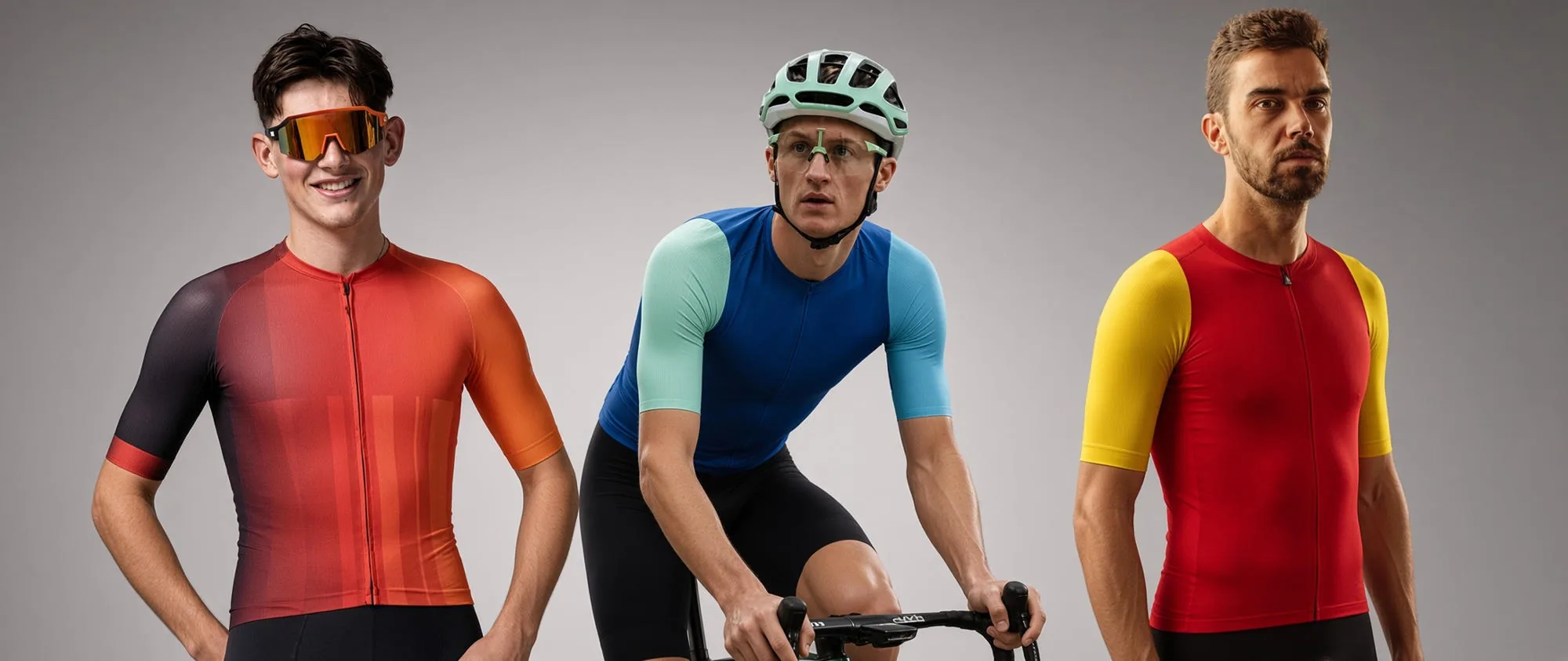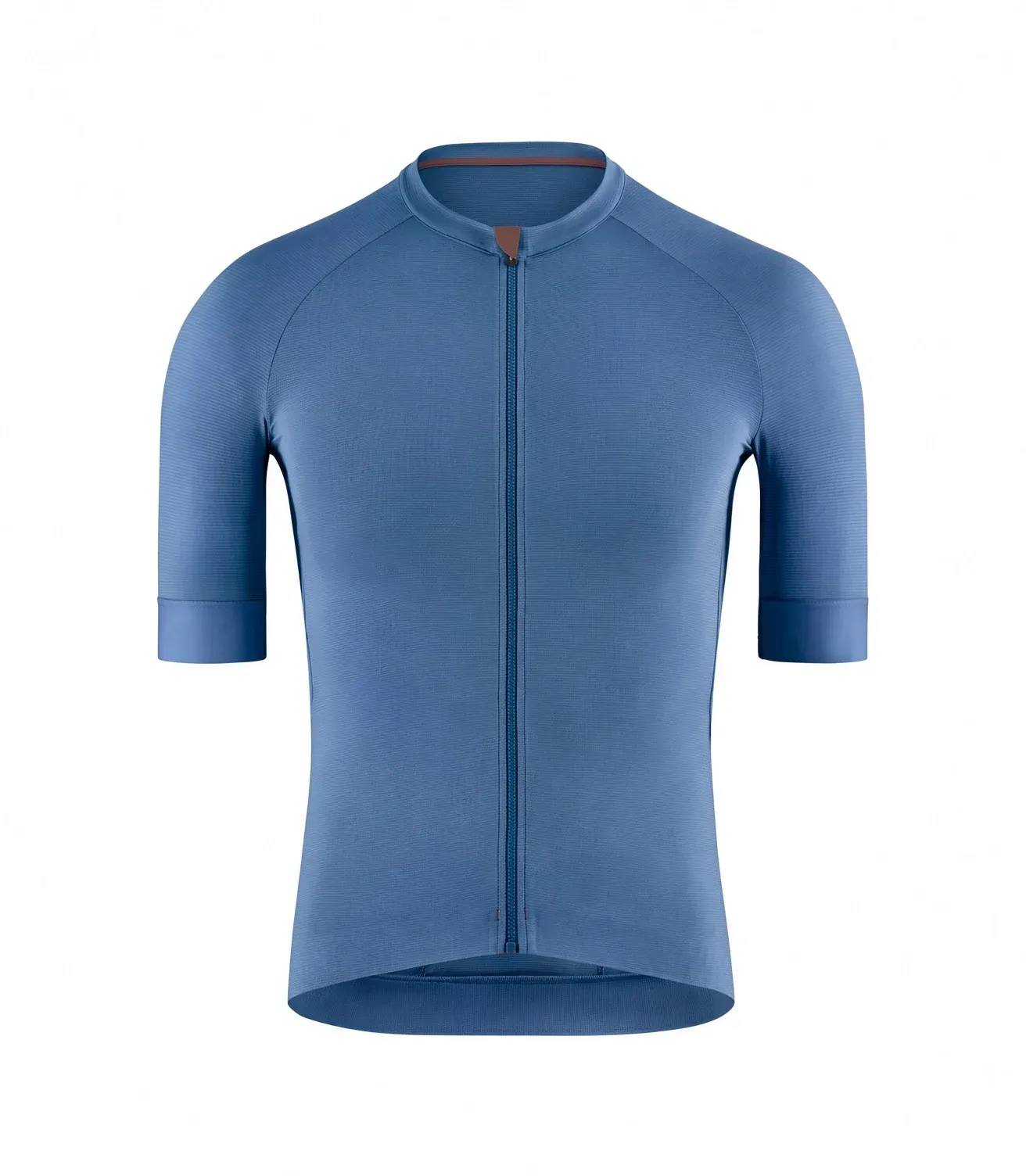
Jersey
CoreEvery rider, every ride
The one piece every member orders. Cut for the leaned-over ride position, full-panel sublimation so crest and sponsor blocks run to the hem.
Most clubs do not fail on the kit design — they fail on the order around it: a member count short of the floor, a size split nobody locked, a sponsor plate that arrived after print, a reorder that had to be rebuilt from scratch. As cycling club kit suppliers since 2012, we build the order system that carries the kit, season after season.
What a Season Actually Buys
A club kit is a bag of pieces, and every distinct piece is its own order with its own floor. Reading the season as tiers — what every rider needs, what the weather adds, what the identity adds — is how a limited member count still reaches the minimum on the pieces that matter first.
Every rider, every ride
The one piece every member orders. Cut for the leaned-over ride position, full-panel sublimation so crest and sponsor blocks run to the hem.
Every rider, distance decides the pad
Same member list as the jersey, but the chamois is chosen by ride length — a club-run pad and an endurance pad are different builds, so the tier is split before the count.
The shoulder-season add
Ordered by the riders who ride through spring and autumn — a smaller count, planned as a second tier rather than folded into the jersey order.
The identity add
Knit accessories start at 50 pieces, so the low-count identity pieces can sit under the garment floor — ordered to the same shade and crest as the jersey.
Each tier below is a separate design, so each clears the 100-unit floor per design per colour on its own. Mixed sizes count toward a single design; a second colourway is a second design.
Who Signs the Order
A club kit has several people with a finger on the order, and each is measured on a different thing — the member count, the sponsor contract, the event date, the shelf, the runway. The same order system answers all of them, but the proof each one needs reads differently.
A volunteer sitting on the member pre-order window, answerable to the committee for the club’s spend.
A member list of forty-something against the floor, riders joining mid-season, and a reorder next year that means rebuilding the spec from a photo because nobody kept the approved sample.
A member pre-order run to clear the 100-unit floor, a reserve cut set inside the main run for mid-season joiners, and the approved spec held against the member’s name for the reorder.
Year two is a quantity change against a spec already on file, not a fresh design project — the pattern behind our 82% reorder rate.
A roster of contracted riders, a set of sponsor obligations and a governing-body rulebook the kit has to satisfy on the start line.
Sponsor marks with size and placement limits, a fit that has to hold in the racing position, and signings that land after the kit order was supposedly closed.
A written placement sheet per sponsor, a fit sample in 5–7 days and a PP sample in 7–10 days, and Pantone matching held to ΔE ≤ 1.5 between the sample and the bulk.
A kit that clears the commissaire’s check and a signed fit sheet before the first start, instead of a rejected kit at sign-on.
A fixed event date, a title sponsor, and an entry list that is unknown until close — with kit that has to be in riders’ hands at the venue.
Late entry surges, a size spread nobody predicted, and a venue delivery that has to clear customs before the event, not after.
A written artwork cut-off, production in 15–25 working days and DDP delivery in 7–15 days straight to the venue or a local 3PL, all back-planned from the event date with a quote in 24 hours.
Kit at registration with a buffer, because the deadline was treated as arithmetic rather than urgency.
A shop plan and a sales curve, buying club-branded kit to sell to walk-in members rather than to kit the club itself.
Best-selling sizes that gap before the season ends, cartons with no barcode that stall at receiving, and a club label that has to sit alongside the shop’s own SKUs.
Barcoded, shelf-ready packing, a size curve planned per slot, and a reorder trigger set against the sales curve — each design at 100 units per colour.
Stock reaches the rail without a receiving re-key, and the reorder fires while a size is low rather than after it has emptied.
A first collection and a budget that cannot afford to sit in stock the market has not tested.
A strong sketch but no tech pack, a first order that has to prove a market, and a landed cost that is not known until the shipment is already booked.
A tech pack built in-house, a first run at 100 units per design, fabrics from 120–350 GSM with full-panel sublimation, landed duty-paid on one costed figure.
A market test on a single landed number, sized to what the first season can actually sell.
Fit Is a Retention Decision
The kit a member pulls on for the Sunday club run is the kit they renew their membership to keep wearing. Whether they reach for it comes down to two build decisions made before the first cut — which ride position the block is cut for, and which pad the distance calls for — not to the fabric story on the label.
More room through the torso; hem sits flat on an upright position.
Closer through the torso; dropped tail and pre-curved sleeves for the drops.
A cycling top gets a dropped tail and pre-curved sleeves so it sits right on the drops, not just standing in the shop. A jersey cut like a T-shirt rides up and gaps at the lower back — and it is the first thing a member complains about.
The knit holds 4-way stretch with under 5% growth, so a pocket loaded with a phone and a gilet does not sag by the end of the ride. Recovery is what keeps the fit looking deliberate in season three.
A club-run pad and an endurance pad are different builds, so the distance the club actually rides decides the chamois before the count is finalised — not a single pad priced for everyone.
Seams are 4-needle, 6-thread flatlock against chafe, and the kit is washed weekly by members. Dimensional stability is tested per fabric lot under ISO 5077, with shrinkage at 1.8% after 50 industrial washes.
The Riding Context
A race kit, a sportive kit, a leisure-club kit, a shop range and a sponsorship programme are not the same order in different colours. Each runs under its own rules and its own deadline, so the programme that carries it changes with the context.
A governed race scene where kit is checked at sign-on against the governing body’s rules on sponsor marks, uniformity and the roster.
A date-led mass-participation ride with a title sponsor, a venue, and an entry list that is unknown until close.
Members pay for and wear their own kit, wash it weekly, and join or leave through the season.
A bike shop selling club-adjacent kit off a rail to walk-in members, alongside its own SKUs.
A sponsor-backed team where the kit is a contract deliverable carrying primary, secondary and supporting marks under exclusivity terms.
The Sponsor Ladder
A sponsor-backed club sells visibility in tiers. Once each tier owns a defined zone and a written rule, the kit becomes a repeatable sales sheet the committee can price — instead of a negotiation about whose logo goes where on the next order.
Zone Chest and upper back
The largest mark on the kit, on the plainest field, where the camera lands.
One primary mark per zone; no competing mark on the same panel.
Zone Sleeves and side panels
A defined share of the visible kit, sized below the primary and clear of it.
Placed in rank order down the sleeve; max two per sleeve to stay legible.
Zone Collar and lower back
A visible credit at a smaller scale, sold as an entry tier for local backers.
Logo files must be vector; screenshots and JPEGs are rejected before print.
Zones are agreed on the artwork sheet before print. Full-panel sublimation lets a primary block sit on a clean colour field so a sponsor mark reads at speed without a panel seam cutting through it.
Before the First Cut
Crest, sponsor tiers, club shade and size split can all be set on one placement proof while the member count is still being collected — every mark sized and cleared before a panel is cut, and the kit costed at the club’s shade rather than a stock colour.
Programme Fit
Cycling club kit runs on a member count, a sponsor sheet and a ride date. Four conditions decide whether a project belongs in this model.
| Boundary | What we take | Not a fit |
|---|---|---|
| Order quantity | 100 units per design per colour — mixed sizes count toward the total, and each tier or colourway is its own design | A club run under 100 that cannot be combined across a pre-order window, or one count split across several colours to reach the number |
| Sponsor & crest authority | Written artwork approval and vector logo files for crest and sponsor marks before bulk | Crest or sponsor marks ordered without written authority, or logo files supplied as screenshots or JPEGs |
| Size lock | A pre-order window with a firm size-lock date, sized from the kit chart | Guessing a roster’s sizes with no lock date, so late changes reopen the cut |
| Ride date | An event or season date inside the real lead times — sampling 5–7 days, production 15–25 working days, DDP 7–15 days | A date that assumes a compressed lead time the line cannot honour |
Reference Desk
The parts of a club kit order that decide the outcome are rarely the fabric. They are the member count against the floor, the sponsor sheet, the size lock and the ride date. These are the references we hand a club before the first proof is cut.
Third-party audited. Current certificate numbers are available to qualified buyers on request.
Club Kit Due Diligence
The questions that come from inside a club order — the member count against the floor, the fit for the ride position, the sponsor sheet, the event date and the landed figure.
Yes — by ordering pieces as their own tiers, not one giant order. The floor is 100 units per design per colour, and mixed sizes count toward the same design. A club runs a member pre-order to clear the floor on the core jersey and bibs, cuts a reserve into that run for mid-season joiners, and orders the low-count identity pieces — caps, socks, musette — as knit accessories from 50 pieces, matched to the same shade and crest. Each piece is planned on its own, so one small tier does not stall the whole kit.
The ride position the block is cut for. A club fit leaves more room through the torso and keeps the hem level for an upright position; a race fit is closer and uses a dropped tail with pre-curved sleeves so the jersey sits right on the drops. Both are cut from the same cycling block, so the choice is made once per design and held for reorders. We confirm it on a fit sample in 5–7 days so the club sees the position before bulk.
Each sponsor tier owns a defined zone and a written rule. Primary sponsors sit on the chest and upper back, secondary sponsors on the sleeves and side panels, supporting sponsors on the collar and lower back — agreed on an artwork sheet before print. Full-panel sublimation lets a primary block sit on a clean colour field without a panel seam cutting through it. Send vector logo files (.AI, .EPS, .SVG or print-ready PDF); screenshots and JPEGs are rejected before print, not after.
Yes — back-planned from the event date, delivered DDP. Production runs 15–25 working days and DDP delivery is 7–15 days door-to-door, straight to the venue or a local 3PL, with duties and final-mile included in one landed figure. Set a written artwork cut-off so the ship date is arithmetic rather than urgency, and we hold that buffer against the event date.
A second colourway is a second design, so it carries its own 100-unit floor; a women’s cut is a separate pattern block. Plan the colours and cuts you need before the count is finalised, so the member pre-order covers each design rather than splitting one number across several. We confirm exactly how a given split is counted at quote time.
Through a pre-order window with a firm size lock. Members submit their size against a size chart during the window; once the lock date passes, the run is cut to that split, so a late change is a new order rather than a quiet adjustment. Cyclists should size from the kit chart, not their T-shirt size — a jersey cut runs closer than everyday clothing. A reserve cut inside the run covers the members who join just after the lock.
Dimensional stability is tested per fabric lot, not assumed. We run ISO 5077 dimensional-stability tests and hold shrinkage to 1.8% after 50 industrial washes, with ISO 105 colourfastness on the same lot. Seams are 4-needle, 6-thread flatlock against chafe, and the knit holds 4-way stretch under 5% growth, so a loaded pocket does not sag by the end of a ride or after a season of washes.
Yes — the approved spec is held against your club. The shade, crest placement, sponsor sheet and pattern block are kept on file, so next season is a quantity change against an approved spec rather than a fresh design project. Pantone matching is held to ΔE ≤ 1.5 between orders, which is the mechanism behind our 82% reorder rate. If the crest or a sponsor changes, only that element is reopened.
Share the roster, the sponsor sheet or the ride date. A costed kit plan with the tier split, the size lock and the landed figure lands within one business day.
Start typing to find articles
No articles found
Try a different keyword