AATCC 162 chlorine-tested

Custom Swimwear Manufacturers Engineered to Recover 92%+

After 300 Stretch Cycles.

Pale-colourway suits are opacity-tested so they never go see-through, and the elastic in the leg and strap bars is speced to bounce back season after season — the construction that decides whether a run comes back.

Custom Swimwear Categories

Each Silhouette, One Lab Standard.

Every category ships with a labeled spec sheet — the fabric grade, GSM band, and build that keep the lab card and PPS aligned.

Custom one-piece swimsuit manufacturing

One-Piece Swimsuits

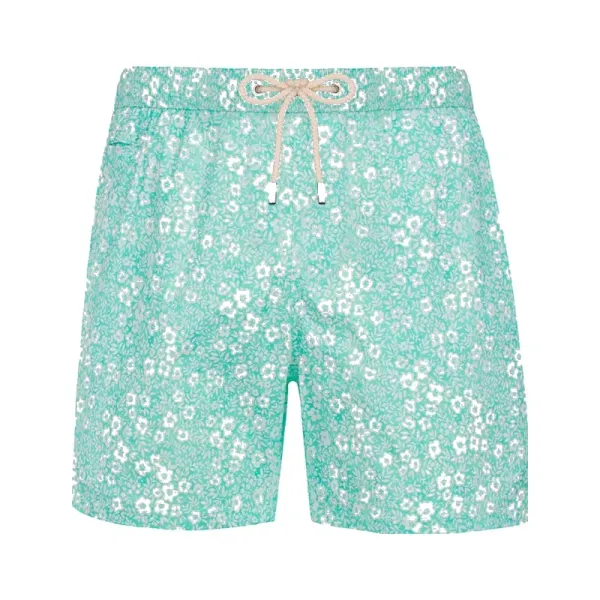
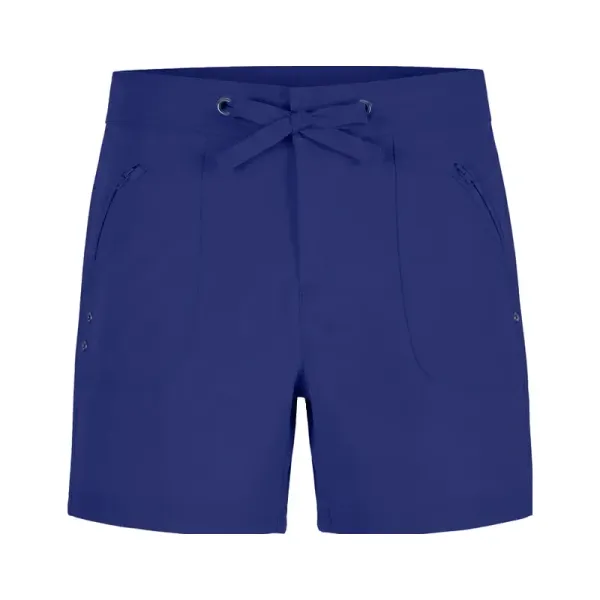
Custom swim shorts manufacturing

Swim Shorts

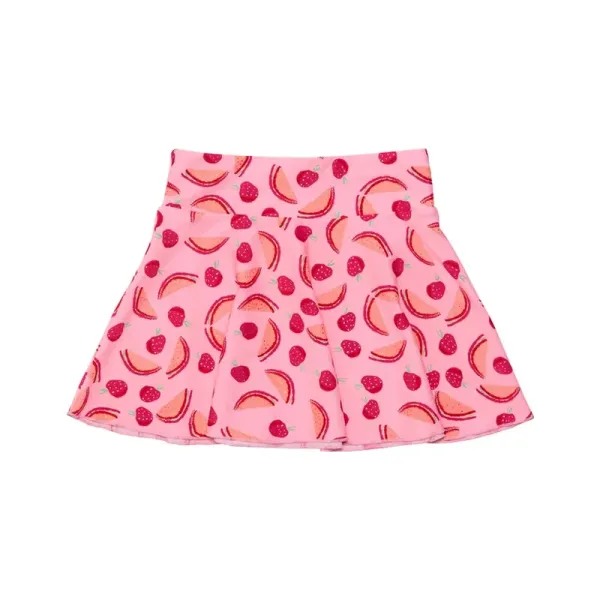
Custom swim skirts manufacturing

Swim Skirts

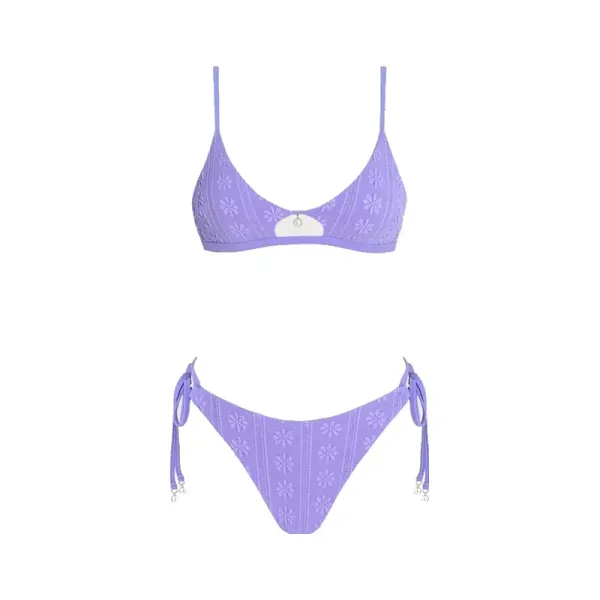
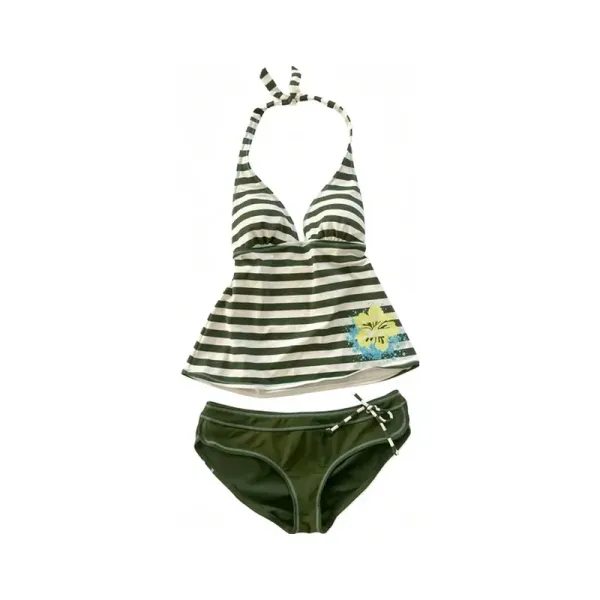
Custom bikini set manufacturing

Bikini Sets

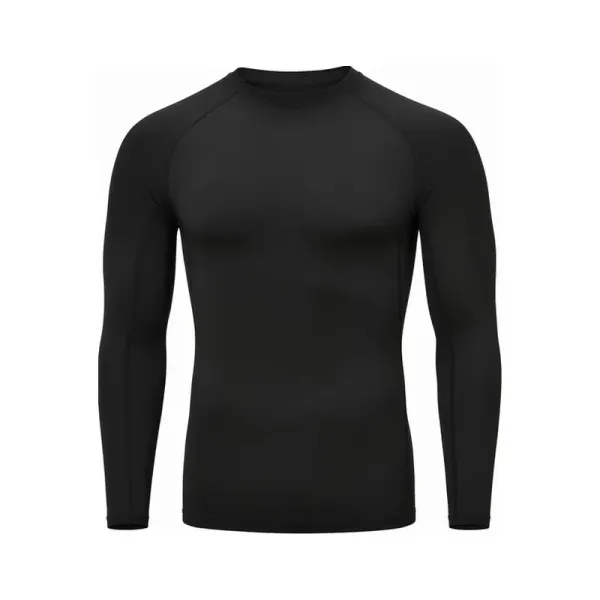
Custom rash guard manufacturing

Rash Guards

Custom board shorts manufacturing

Board Shorts

Custom tankini manufacturing

Tankinis

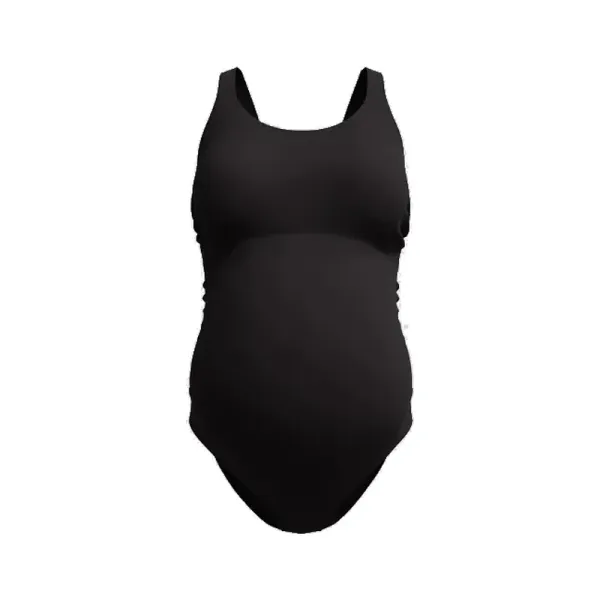
Custom maternity swimwear manufacturing

Maternity Swimwear

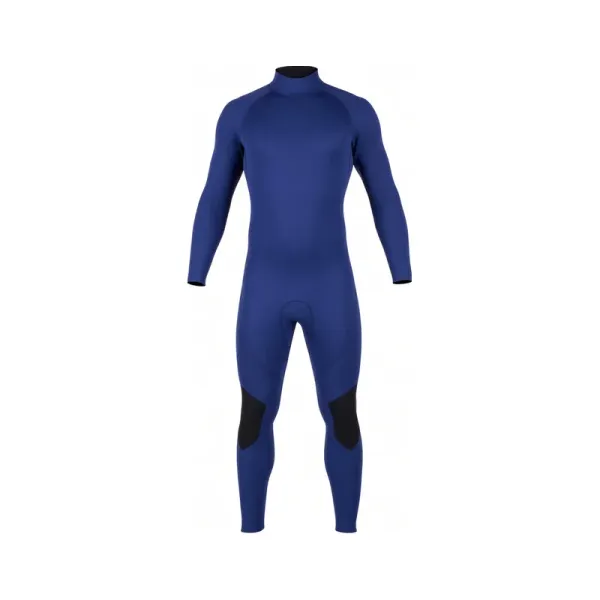
Custom surf suit manufacturing

Surf Suits

Fabric Performance Lab

Six Tests, Passed Before Bulk.

A swimwear program opens with a lab card, not a mood board — fabric tested to industry methods, the pass/fail line set by you, on record before bulk is cut.

FABRIC PERFORMANCE LAB
01

Chlorine Endurance

AATCC 162
Grade 4+

Pool-safe past 60 swims

Suits that fade after three chlorinated pools get returned. Grade 4+ is the premium line a brand can stand behind.

02

Stretch + Recovery

PPS tensile
92%

After 300 stretch cycles

A suit that stays stretched out of shape loses its fit by week two. Recovery is tested at 30, 60, and 300 cycles on the PPS swatch.

03

Opacity / Sheerness

Line test
PASS

180 GSM single-layer, white

Light colours expose the difference between 180 GSM and a thin two-way knit. The line test settles it before you commit to a colourway.

04

Fabric Weight

GSM
190 GSM

Within 180–220 band

Weight drives opacity, recovery, and price. The GSM band is locked on the quote so bulk can't silently trade down to a lighter knit.

05

Shrinkage

ISO 5077
≤3%

Stays put after wash

A swimsuit that shrinks at the leg opening is a fit failure, not a washing complaint. Measured post-wash, never pre-wash.

06

Colourfastness

Gray Scale
4–5

Holds its shade, resists bleed

Colour bleed ruins a white bikini in the same wash load. The swatch is assessed on the Gray Scale before the dye lot is sealed.

Control fabric required with the chlorine runPPS sealed in the correct fabric before bulkDigital sublimation print has no meter minimum

Construction

How It is Put Together.

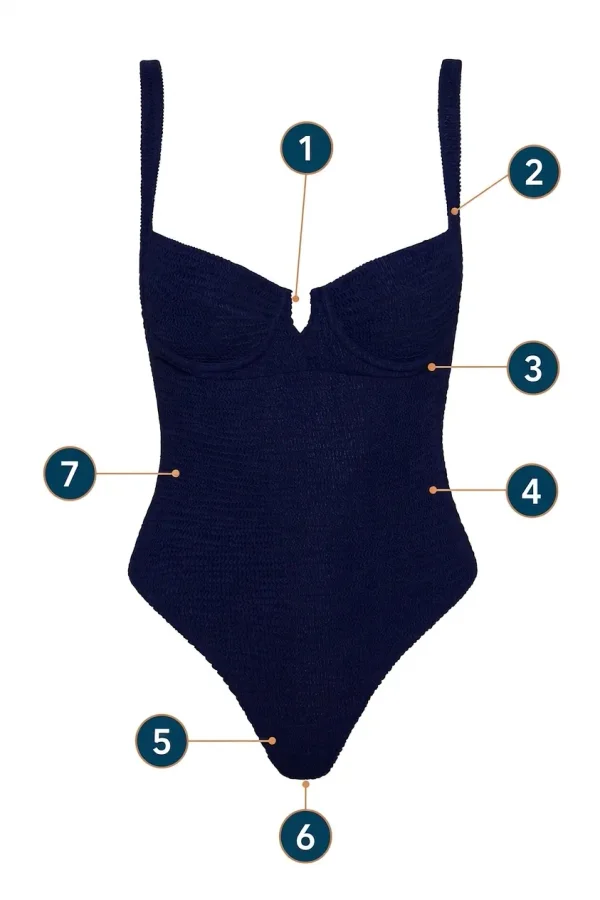
A detail on the diagram is a spec, not a styling choice — the construction points that stop a suit losing its shape, liner, or seams.

Annotated swimwear construction diagram with numbered callouts
1

Neckline & strap binding

  • 3/8" elastic folded in
  • Chlorine-safe — sits flat, no cut-in
2

Strap attach

  • Bar-tacked at the stress point
  • Pull-tested at 30–50 N
3

Waist seam

  • Flatlock on the stretch panel
  • Negative ease — moves with the body
4

Side seam

  • 4-thread flatlock, 1/4" allowance
  • Built for two-way stretch
5

Leg opening

  • 5/8" elastic tuned for recovery
  • Snaps back — no mid-season sag
6

Bottoms hems & cover-stitch

  • Cover-stitched on the stretch edge
  • Chlorine-safe thread — no popped seams in the pool

Customization, Built Into the Spec.

Custom Print

Your Pattern, Printed Without the Minimum.

Digital sublimation prints your pattern at a near-zero meter minimum — skipping the 300–1,000 m fabric order entirely, with ink that won't crack. Validate a print small, then scale it to bulk rotary.

Custom Branding

Your Label, On Every Touchpoint.

Private label means the brand on the garment is yours. Each touchpoint — the chest mark, the chlorine spec, the care label — carries your name.

Chest & drawcord logo

A soft silicon stamp on the chest or a logo on the drawcord tips — the mark sits where a bikini or swim bottom actually wears it, and it stretches with the fabric instead of cracking like a flat print.

Chlorine-tested label

AATCC 162 chlorine-resistance sewn where the buyer looks for it — the spec that separates a swim run from a one-season suit.

UPF 50+ & wash care label

Fabric content beside a UPF 50+ rating, with cold-wash and no-heat care — so a pale colourway holds its coverage and its fit through a season of pools.

Custom Fit

Fit on the Stretch, No Guesswork.

Return your size table and the pattern is built to it. Swimwear grades on negative ease — the stretch, not the relaxed measurement — so the fit tracks the customer at any order size.

Negative ease −7 to −10% across the size run — the grade reference is the stretched fabric, not the tape measure.

Swimwear Tech Pack

Sketch to Spec, Before the Quote.

No finished tech pack needed to start — send the sketch and brief, and the pack is built before the quote is based on the spec, not the sketch.

01

Flat sketches

Front, back, and interior views with seam lines and stitch symbols, so the sewer and the buyer look at the same drawing.

02

Bill of materials

Fabric composition and GSM, lining specification, elastic type and width, thread, trims, and labels — every component with a reference.

03

Size spec sheet

Your measurement table translated into the size run — the grade reference for the fit, set against the fabric's stretch (see the fit & grading block).

04

Stitch & construction

4-thread flatlock or 3-step zigzag callouts, seam allowances, and elastic tension ranges — the numbers the line sews to.

05

Colourways

Pantone references matched with a spectrophotometer to 99.8% against the standard, sealed before the dye lot runs.

06

Fit tolerance

±0.5 cm on body measurements, so a "medium" means the same thing on the table and in the box.

Sketch-only orders are fine. A swimwear tech pack has to carry negative ease, elastic specs, and stitch construction — and building that from a sketch is part of the service, not a premium add-on.

Swimwear Pricing

The Price Tracks the Fabric, Not the Label.

Most of a swimsuit's cost is decided before sewing — in the fabric grade and print method. The band below shows what each level pays for, in FOB per piece.

$8–14 Base
  • Standard Lycra / poly knit
  • Solid colours, stock fabric
  • Rotary print or plain
$22–38 Premium
  • Grade 4+, ECONYL or Carvico
  • 200–220 GSM, two-layer where needed
  • Sun-rated 50+, premium hardware

MOQ

Minimum Order Quantities.

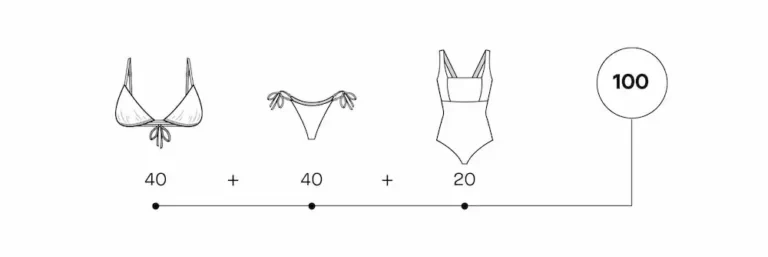
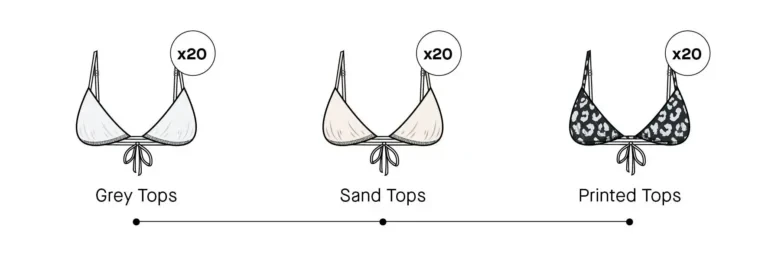
Lowest-in-industry MOQs — 100 pieces per order, 20 per style, color, or print, samples with no minimum, discounts that scale with volume.

Combine products to reach a total order of 100. In any style you order, minimum 20 per color or print.

Combine products to reach total MOQ of 100
Minimum 20 pieces per color or print

Feel the Fabric First

Test the Chlorine Before You Commit.

Request a swatch set from the actual rolls — bodies, lining, and elastics, matched to a target price band.

Sustainably Made

Sustainably Made, Globally Worn.

Sustainable swimwear that works for people and planet alike.

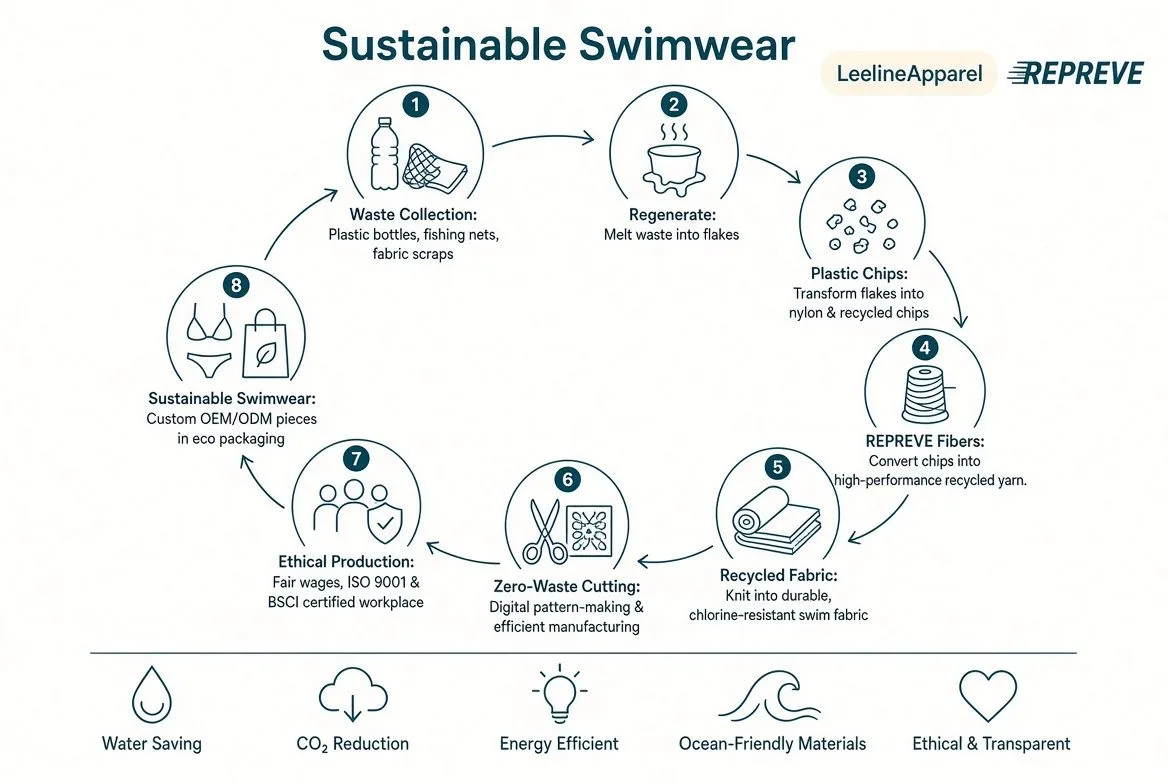
Sustainable swimwear fabric and ocean-toned production

Performance Meets Planet

Advanced recycling turns waste into body-fitting designs. Recycled nylon and polyester keep the chlorine grade and stretch the lab demands.

Impact Built Into Every Run

A bikini supports ocean conservation and women’s education — the purpose travels with the product.

Claims With Paperwork

Recycled content counts only when it can be traced. Sustainable fabric ships with its documentation attached.

Sustainable fabrics
ECONYL Regenerated nylon

Nylon from fishing nets and carpet waste, with GRS chain-of-custody for premium one-pieces and rash guards.

REPREVE Recycled polyester

Strong and chlorine-tolerant — the call for board shorts and linings at scale.

Carvico / Vita Italian performance knits

High-recovery Italian swim knits for labels selling on fit and hand-feel.

Cases from Custom Swimwear

Swimwear Buyer Stories, Told By the Buyers.

What swimwear buyers say after their first run — real projects, real timelines, real follow-through.

★★★★★

My last supplier called every suit "chlorine-resistant" and none came with a grade. LeelineApparel put Grade 4+ on the lab card I signed at the PPS, tested against the control fabric.

The shape problem was the recovery, not the fabric. They test at 30, 60, and 300 cycles with a 92%+ recovery target, then spec the elastic and flatlock to match.

They ran an opacity line-test on the actual swatch before we sampled. Anything pale moved up to 180 GSM single layer, and I approved it before a meter was cut.

I only had sketches, no tech pack, and it still took 4–12 weeks brief to finished goods. Nothing slipped behind a vague "4–6 weeks" promise.

Emma Carter, swimwear brand founder
Emma Carter Swimwear Brand Founder
★★★★★

I run a fast label, so the 100-piece minimum got me in the door — but the minimum that bites is fabric, not sewing. They told me the 300–1,000 meter mill minimum before I sampled, then ran one base fabric and one dye lot for three SKUs.

They put the artwork on digital sublimation printing at near-zero meter minimum instead of a mill order, and moved to rotary print only after it proved in the market.

The eco fabrics came with paperwork, not a badge. Every ECONYL and REPREVE lot shipped with a GRS chain-of-custody certificate, so I don’t have to defend a "recycled" claim.

Shipping was the last thing I expected to be on time. Finished pieces passed 100% metal detection, and straps were pull-tested at 30–50 N — critical defects held the lot. DDP to my door.

Liam Park, swim label buyer
Liam Park Fast-Paced Swim Label Buyer

Swimwear Buyer Concerns

Frequently Asked Questions About Custom Swimwear Manufacturers

A swimwear listing says "chlorine-resistant" — why did my last suits still fade?

Chlorine resistance is a graded test, not a claim. It is measured with AATCC Test Method 162, and the pass/fail line is set by the brand: Grade 3–4 for a mid-tier program, Grade 4+ for premium. Most factories quote the words without ever showing a grade. The report only counts if the run includes the AATCC control fabric — an invalid control voids the whole test. On this page, the grade and the control result are both on the lab card you sign at the PPS, so "chlorine-resistant" is a number, not a promise.

Can I really start at 100 pieces? And is that the real minimum?

100 units per style is the entry point, with tiered pricing at 100, 500, and 1,000. But the minimum that usually bites is fabric, not sewing: a custom-dyed or rotary-printed fabric carries a 300–1,000 meter mill minimum. The two workarounds are running three silhouettes on one base fabric and one dye lot — one mill minimum, three SKUs — or digital sublimation printing to test prints at a near-zero meter minimum. The quote tells you which minimum applies before you sample.

What is actually different in a swimwear tech pack compared to a t-shirt pack?

Four things. Negative ease in the grading rules — swimwear is graded on the stretched fabric, not the relaxed body. An elastic spec: type, width, and tension, because a 5/8" leg elastic and a 3/8" neckline behave differently. Stitch construction — 4-thread flatlock or 3-step zigzag where seams have to stretch. And fabric + lining GSM so opacity holds in light colours. If you only have sketches, that is fine — the pack gets built for you before quoting.

Why do light-colour suits go see-through, and how do I stop it?

Opacity is decided by the fabric, not the print. A white or pastel suit needs 180 GSM and above in a single layer, or a two-layer construction. An opacity line-test runs on the actual swatch — you approve the swatch, and the result is recorded on the lab card. The same design printed on a thin 150 GSM knit is exactly how a brand ends up with returns it can't explain.

I want to test a print before committing to a big fabric order. Is that possible?

Yes — digital sublimation printing carries a near-zero meter minimum, which is how small brands validate a print before scaling. Once the print is proven in the market, the same artwork can move to a bulk rotary print at the mill minimum. The print method is written into the quote, so the meter minimum never shows up as a surprise after sampling.

My last supplier's suits lost their shape by mid-season. Is that the fabric or the construction?

It is the recovery, and recovery is a measured property. The fabric is tested at 30, 60, and 300 stretch cycles, with a target of 92%+ recovery; the elastic type, width, and tension decide whether a strap or leg opening snaps back; and the stitch (flatlock where seams must stretch) keeps the panel from bagging. A suit that stays stretched out failed the recovery test — the customer didn't. That result is on the PPS swatch before bulk.

How do I know the "recycled" fabric a factory quotes is actually recycled?

Recycled content only counts with chain-of-custody paperwork — a GRS Transaction Certificate — not a label or a marketing page. ECONYL and REPREVE come with that documentation; OEKO-TEX Standard 100 covers the chemical safety of the finish. Greenwashing is a brand liability, so on this page the document ships with the fabric, not the adjective.

What is the real swimwear lead time — and where does it actually slip?

Sample development runs 2–4 weeks, fit revisions 1–3 weeks, bulk production 2–6 weeks — roughly 4–12 weeks between brief and finished goods, before shipping. The slip is rarely in the sewing line. It is in the fabric (dye-lot or print approval) and the season (the October-to-February high season and Chinese New Year shutdown). Both are buffered into the written calendar timeline, not hidden behind a "4–6 weeks" phrase.

What stops a swimwear drop from failing publicly — a broken needle or a missing liner?

Four checks happen before anything ships. 100% metal detection on finished pieces with a 0% tolerance for fragments. A hygiene liner sewn into a bikini bottom — it is a QC critical, not an extra. A 30–50 N pull test on straps and bar-tacks. And chlorine spot tests on the production dye lot. Critical defects hold the lot rather than shipping it.

Approve the Sample, Skip the Gamble.

Send a sketch or tech pack — get a chlorine-grade recommendation, fabric swatch set, and a milestone-based quote before a meter is cut.

Request a Quote