
Table of Contents
Jeans manufacturers in China fall into three groups: high-volume OEM factories (500,000+ units a year, 45–70 day lead times, MOQ usually 300+), flexible mid-size factories (150,000–400,000 units, 50–100 piece trial runs, 30–50 day lead times), and specialist wash or sustainable-denim houses.
Before shortlisting, three things are worth verifying: auditable AQL 2.5 inspection records, DDP door-to-door capability, and a current GOTS or OEKO-TEX certificate.
For brands selling under 50,000 units a year, low MOQ and 7–10 day prototyping matter more than raw capacity. For retail chains, export experience and backup capacity across multiple factories matter more. The nine factories below are listed with the public supplier profile behind each figure.
Nine Denim Factories Compared by Capacity, Lead Time and MOQ
| Factory | Scale & annual capacity | Core specialism | Production lead time | Export track record | Custom work | Best suited to | A poor fit for |
|---|---|---|---|---|---|---|---|
| JUAJEANS | 500k+/year | Raw denim, vintage washes | 60 days | 15+ years | Yes | Denim-heavy capsule ranges | Brands needing 30-day turnaround |
| Foshan Shunde Tianxiu | 700k+/year | Men’s & women’s denim | 30–45 days | Direct export | Yes | Large men’s and women’s denim runs | Premium selvedge programmes |
| Guangzhou Lepanchuang | 300k+/year | Stretch denim, trendy fits | 45–60 days | 10+ years | Limited | Trend-driven mid-size orders | Startups needing under-100 MOQ |
| Dongguan Xiaofeiniu | 200k+/year | Budget-friendly denim | 60–75 days | OEM partnerships | No | Small trial runs and tight budgets | Speed-critical or premium denim |
| Guangzhou Yiluhong | 400k+/year | Plus-size & adaptive denim | 50 days | Global retail chains | Yes | Plus-size and adaptive ranges | Fast-fashion trend cycles |
| Guangzhou Qianniu | 600k+/year | Workwear & heavy-duty denim | 55 days | Industrial suppliers | No | Workwear and heavy-duty denim | Fashion boutiques |
| JIMJEANS | 350k+/year | Premium selvedge denim | 90 days | Luxury boutiques | Yes | Premium selvedge at scale | Fast-fashion deadlines |
| Shandong Wanji | 250k+/year | Fast-fashion denim | 30–90 days | Direct export | Yes | Fast-fashion basics at flexible volumes | Premium finishes or selvedge |
| Maya Garment | 150k+/year | Eco-denim (recycled materials) | 70 days | EU/US specialty brands | Yes | Eco-focused brands, multi-fabric ranges | Rush orders or rock-bottom pricing |
Capacity, lead time and export figures are drawn from each factory’s public supplier profiles and were last reviewed in October 2026. Treat this as a starting shortlist, not a guarantee — confirm current MOQ, lead time and certifications by requesting a quote, and where possible an on-site audit.
How to Shortlist in Three Steps
The table above is a starting point, not a decision. Narrow it down like this:
- Sort by MOQ band. Under 100 pieces per style puts a factory in trial-run territory (Xiaofeiniu, Maya, Yiluhong). Between 100 and 500 is the growth band most brands sit in. Above 500, capacity and lead-time reliability matter more than flexibility.
- Filter by wash capability. Ask whether the factory does garment wash and laser distressing in-house or outsources it — outsourced finishing adds 10–15 days and blurs who owns quality when something goes wrong.
- Request three proofs before talking price. A sample lead-time commitment, a recent AQL 2.5 inspection report, and a current certification scan, each dated within the last twelve months — then hold every candidate to the same factory audit checklist.
Confirm certification claims at source — OEKO-TEX Standard 100 and GOTS both publish what a valid certificate must state.
Once those three answers are in from each factory, the comparison becomes like for like — and the shortlist usually falls to two or three names on its own.
1. JUAJEANS
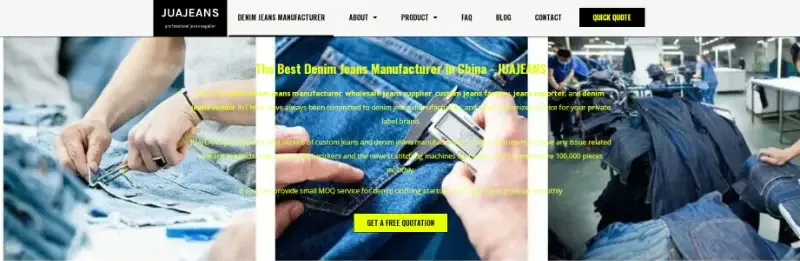
JUAJEANS is a denim factory that suits brands wanting raw denim and vintage washes under private label or OEM, with low-volume runs of 300 pieces per style.
Product Offerings
- Variety of Products: JUAJEANS offers a wide range of denim items including:
- Jeans pants
- Denim jackets
- Denim skirts
- Denim shorts
- Customization Options: Fits, washes, and designs can be tailored for men, women, and kids.
Key Advantages
- Trendy Styles: The widest selection of denim styles, spanning skinny to wide-leg, matches current fashion demand.
- Quick Turnaround: Rapid sampling and production adapts to market trends, getting products to market faster.
- Global Market Reach: With a focus on the UK, US, and Europe, JUAJEANS maintains competitive wholesale pricing.
- One-Stop Service: Unique private-label collections can be built from tech packs, original samples, or size specs.
- Low-Volume Runs: Designed for emerging Chinese jeans brands, production starts at 300 pieces per style/color.
2. Foshan Shunde Tianxiu Garment Co., Ltd.
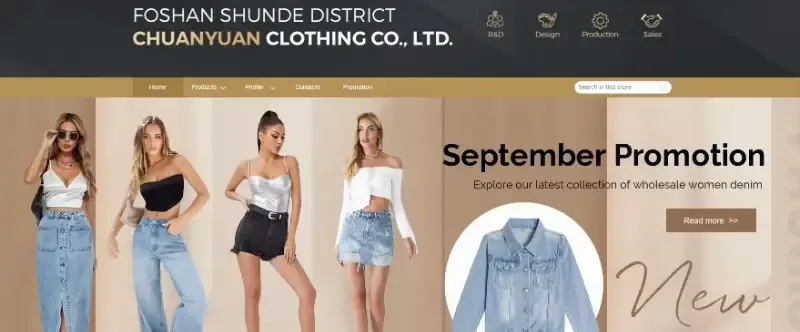
Foshan Shunde Tianxiu is a men’s and women’s denim factory in Guangdong offering sample-to-bulk development, producing over 700,000 garments a year with in-house washing.
Key Highlights
- High Production Capacity: This jeans supplier in China can produce more than 700,000 garments annually.
- Skilled Workforce: Around 86 skilled employees work diligently to ensure quality.
- Modern Facilities: Their workshops are equipped for both garment production and washing.
- New in the Market: Registered in 2022, it quickly became a trusted supplier.
- Quality Assurance: Holds QC 080000 accreditation, showcasing rigorous quality management.
- Diverse Offerings: Specializes in various woven fabrics, focusing mainly on denim for men and women.
Expert Advice: Small-batch pilot orders to test new denim innovations risk-free. Their modern facilities enable quick design changes. There are no minimum volume lock-ins, which is perfect for trend-driven collections.
Shakeel Ahmed, manufacturers & traders jeans
Industry Reputation
- Recognized as one of the top 10 China jeans manufacturers, the company is noted for its reliability, scalability, and speed.
- It serves international clients with an emphasis on quick turnarounds without compromising quality.
3. Guangzhou Lepanchuang Garment Co., Ltd
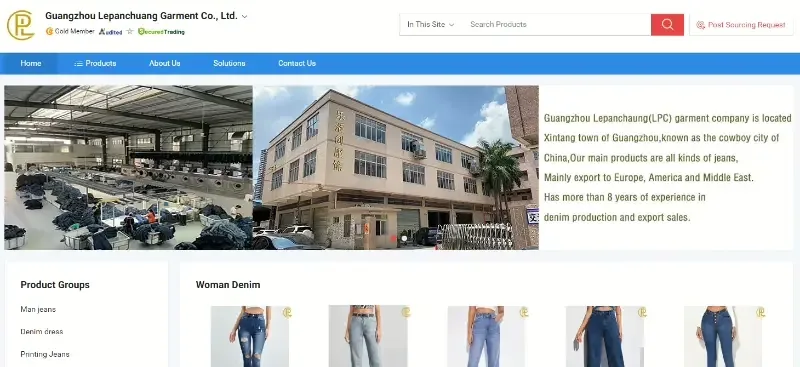
Guangzhou Lepanchuang is a stretch-denim and trend-fit factory in Xintang — Guangdong’s denim hub — that suits mid-size orders, running ten production lines from a 5,000 sq m facility established in 2016.
Key Offerings and Capabilities
- Main Products: A wide range of denim apparel, catering to both men and women.
- Production Capacity: Over ten production lines and 450 skilled seamstresses keep medium volumes on schedule.
- Minimum Order Quantity: The minimum order is 500 units for bulk denim runs.
- Price Range: Unit pricing depends on design and quantity — request a current quote for the spec.
Logistics and Efficiency
- Export Advantages: An export license supports faster delivery times than many competitors, and key ports in Guangzhou and Shenzhen streamline shipping.
- Payment Terms: Accepted methods include T/T, D/P, Western Union, and MoneyGram.
Want to know more about clothing manufacturers in Guangzhou China?
4. Dongguan Xiaofeiniu Garment Co., Ltd.
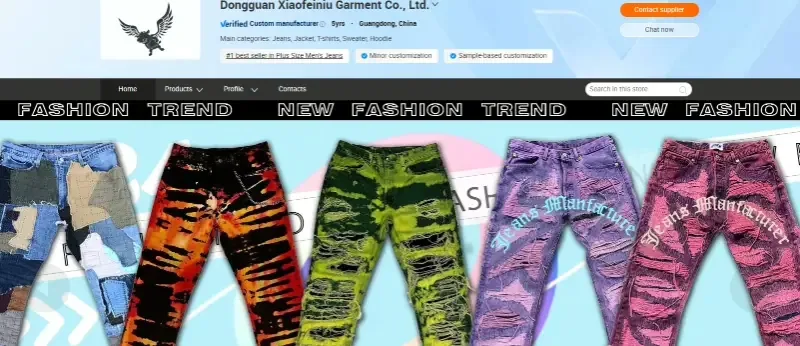
Dongguan Xiaofeiniu is a budget-denim factory in Dongguan that suits small trial runs, offering an MOQ of 30 pieces per style and certification to ISO 9001, BSCI and OEKO-TEX.
Key Features and Benefits
- Flexible Minimum Order Quantity: An MOQ of just 30 pieces per style supports full customization.
- Fast Turnaround Times: Sample lead time of 15–20 days and production of 30–45 days keep orders moving.
- Certifications: Certified with ISO 9001, BSCI, and OEKO-TEX, meeting international quality standards.
- Eco-Friendly Practices: A focus on sustainable production suits environmentally conscious Chinese jeans brands.
Positive Client Feedback
- Clients praise the excellent fabric quality, attention to detail, and strong communication.
5. Guangzhou Yiluhong Garment Co., Ltd.
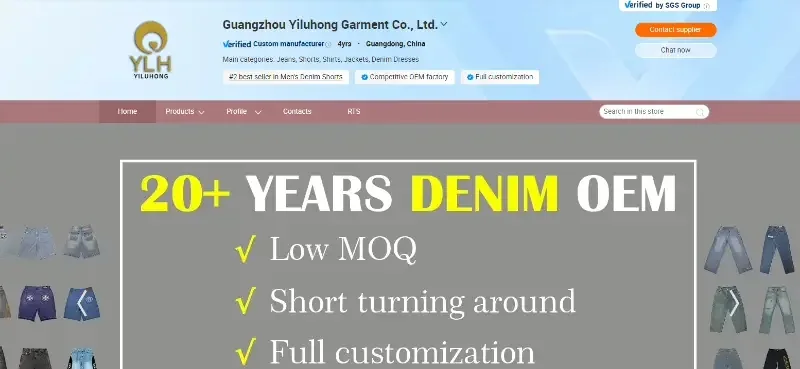
Guangzhou Yiluhong is a denim factory that suits plus-size and adaptive ranges as well as standard fits, offering ODM and full customization with production across Jiangxi, Guangdong and Fujian.
Key Offerings and Services
- Full Customization: Unique designs can be created and adjusted quickly to market needs.
- ODM Services: Original design manufacturing brings new ideas to production.
- One-Stop Supply Chain: This solution covers both small batch and bulk orders.
Competitive Advantages
- Flexibility for Small Orders: Ideal for startups and small businesses, custom denim production runs without high minimums.
- Integrated Supply Chain: Streamlined production across design and delivery shortens time to market.
- Global Distribution: Factories in Jiangxi, Guangdong, and Fujian provinces support efficient international shipping. Looking for Canadian jeans manufacturers? View now.
6. Guangzhou Qianniu Garment Co., Ltd.
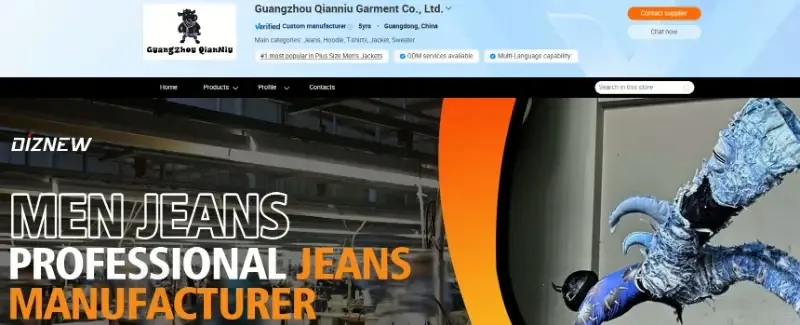
Guangzhou Qianniu is a workwear and heavy-duty denim factory established in 2020 that suits industrial-supply orders, running OEM and ODM work with flexible design changes.
Manufacturing Strengths
Their manufacturing capabilities include:
- Experienced order handling across both OEM and ODM models, accommodating specific Chinese denim brands’ needs
Quality and Flexibility
Notable strengths:
- Customization: Well-recognized for flexibility with design changes.
- Competitive pricing: This can enhance product margins.
- Rapid turnaround: Quick response times for order fulfillment help meet market demands.
- Quality control: High standards are maintained throughout production.
7. JIMJEANS
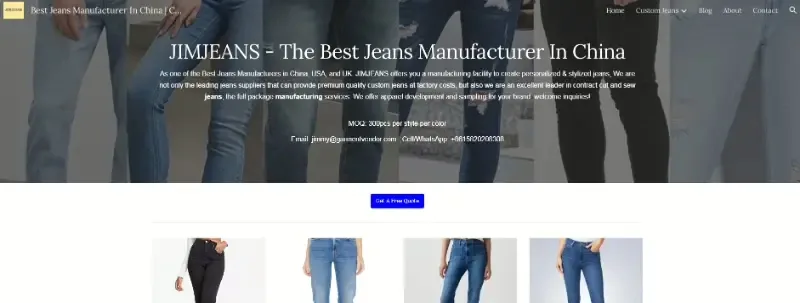
JIMJEANS is a premium selvedge denim factory with around 500 staff that suits luxury and boutique ranges, known for skinny and slim fits at high sewing volume.
Specializations and Expertise
- Best Skinny Jeans Manufacturer: Known for expertise in both skinny and slim-fit jeans.
- Diverse Production Capabilities: Jeans for women, men, and kids across various styles and treatments.
- Exceptional Craftsmanship: A focus on innovative techniques and consistent quality at scale.
Facilities and Communication
- Modern Equipment: High-volume sewing machines support large orders without sacrificing quality.
- Direct Contact Options: Email or WhatsApp gives a fast route to inquiries.
Want to explore what brands are made in Cambodia? Click now!
8. Shandong Wanji Trading Co., Ltd.
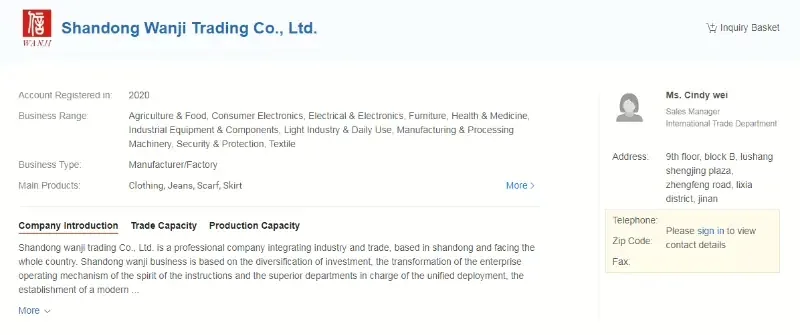
Shandong Wanji is a fast-fashion denim factory in Shandong that suits flexible volumes from small to bulk, exporting directly with lead times of 1–3 months.
Key Benefits
- Direct Exports: With an independent export license, Shandong Wanji handles direct exports, eliminating middlemen and reducing costs.
- Fast Lead Times: Lead times of 1–3 months hold steady even during peak seasons.
- Diverse Product Range: The portfolio includes various jeans styles:
- Blue trousers jeans
- Skinny denim jeans
- Regular fit jeans
- Black fit men’s jeans
- Denim skirts
- Flexible Order Management: Both small and bulk orders are accommodated, and flexible production lines adapt to any order size.
Pro Tip: Leverage rapid 1–3 month lead times to synchronize production with real-time sales data. Enable dynamic restocking of best-selling styles while minimizing deadstock.
9. Maya Garment Co., Limited
Maya Garment is an eco-denim factory with around 150 workers that suits recycled-material and specialty-wash programmes, producing 80,000–100,000 pieces a month at a minimum of 50 pieces per style.
Product Range and Customization
- Fabric Variety: Woven fabrics such as denim, corduroy and twill, in weights spanning 6.5oz to 14.5oz.
- Customization Options: OEM and ODM services support a private label launch. Orders start at 50 pieces per style, color, or wash.
Washing Techniques
- Diverse Finishes: Techniques include garment wash, bleach, and distressed effects, plus advanced finishes for high-end fashion.
- Quality Checks: Every order is checked before shipping, with replacements offered where faults surface. Chinese swimwear brands are also practicing this approach.
Where LeelineApparel Fits
The nine factories above are third-party suppliers. LeelineApparel is a Wuhan-based cut-and-sew manufacturer that runs denim production in-house — over 200 denim fabrics, 500+ hardware options, and a minimum order of 100 pieces per design per color.
Prototypes take 7–10 days and standard denim production runs 30–45 working days, with third-party inspection before dispatch. For brands that would rather work with one team across spec review, sampling, bulk and inspection than coordinate several vendors, that’s the alternative.

Conclusion
Jeans manufacturers in China shape a brand’s success through three trade-offs: cost, durability, and speed. Shortlist on wash capability and finishing control rather than price alone, and confirm every figure by requesting a quote before committing to a season.
People Also Ask About Jeans Manufacturers in China
1. How long does denim sampling usually take?
Initial samples run 2–3 weeks. Factories that use 3D virtual prototyping can often cut this to about 10 days, which matters most when you are testing several washes or fits at once.
2. What MOQ should I expect for a first denim run?
Flexible factories start at 50–100 pieces per style, color or wash. High-volume OEM factories usually require 300 or more, and selvedge or specialist mills can be higher still. Match the MOQ to your first season’s realistic sell-through rather than the lowest number you can find.
3. Are there hidden costs like import duties or logistics fees?
Ask for FOB or DDP pricing up front. A DDP quote should state whether it includes tariffs, certification paperwork and door-to-door freight with no surcharges. If a factory only quotes FOB, budget separately for duty and last-mile delivery before you compare prices.
4. How do I verify a manufacturer’s sustainability claims?
Request current certificate scans (GOTS for organic cotton, OEKO-TEX for chemical safety) and check the issue and expiry dates, since certificates lapse. Ask for water-recycling or chemical-management data in writing rather than accepting a verbal claim.
5. Which orders are a poor fit for a low-MOQ factory?
Rush orders under 30 days and full selvedge programmes usually need a specialist mill rather than a flexible cut-and-sew factory. Expect 60–90 days for selvedge and premium washes, and confirm the schedule before you commit to a launch date.
6. What are the most common sourcing mistakes?
Skipping the AQL 2.5 inspection before shipment, accepting a unit price with no date attached, and choosing on production capacity alone instead of wash capability and finishing control. Each one shows up later as rework, dead stock or a missed season.
