
Table of Contents
A digital design file is not a manufacturing instruction. On a monitor, color is generated by light (RGB), but in a factory, it is created by physical pigments absorbed by fiber. This fundamental disconnect is why a “vintage sage” sample often arrives as “hospital scrub green” in bulk production.
To bridge this gap, technical designers rely on Pantone for fashion design—specifically the Fashion, Home + Interiors (FHI) system. This is not merely a trend tool. It is a rigid coordinate system that acts as a binding contract between a design studio and a clothing manufacturer’s dye house.
This guide outlines the operational side of color management for indie brands and students. To stop guessing, you must first understand the language of the dye house.

- What is Pantone for Fashion Design?
- Core Concepts: The Pantone Production Workflow
- Key Benefits: The ROI of Precision Color Control
- Challenges & Limitations: The Reality Check
- Conclusion
What is Pantone for Fashion Design?
Pantone for fashion design is a standardized color communication system known as Fashion, Home + Interiors (FHI). Unlike digital color spaces (RGB) or print models (CMYK), the fashion home interiors color system uses specific dye recipes to ensure a color matches consistently across different materials. It functions as a manufacturing “North Star”: it ensures the shade you approve in a design studio is exactly what comes off the production line in the factory.
Core Concepts: The Pantone Production Workflow
Color management is not an artistic process. It is a rigorous supply chain protocol. To replicate a specific shade of “Navy Blue” on 500 hoodies manufactured 7,000 miles away, designers must treat color as executable data. The system relies on a strict “Chain of Custody” where a digital concept is anchored to a physical standard, replicated by a mill, and verified through metrics.
1) The Color Communication Chain
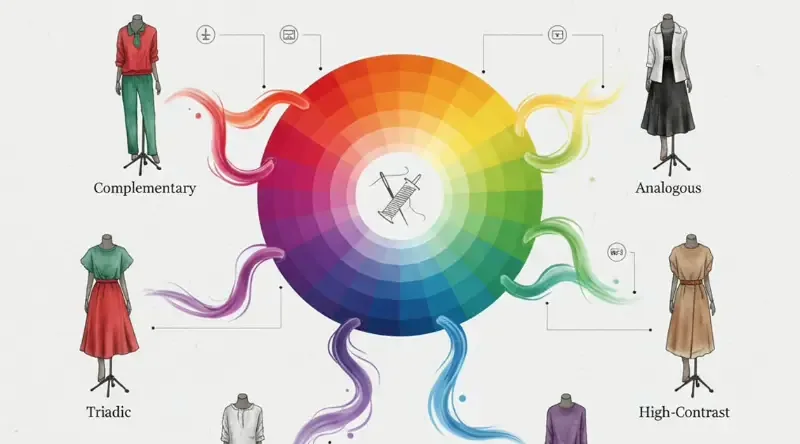
Production errors occur when this chain of custody breaks. The industrial standard workflow follows a linear path:
- Specification: The designer selects a target color and anchors it to a Physical Standard (a specific TCX/TPG swatch).
- Lab Dip: The mill produces a small dyed test swatch attempting to match the standard.
- Verification: The brand reviews the dip under standardized lighting (D65).
- Bulk Production: The factory dyes the production roll based on the Approved Lab Dip, not the original Pantone book.
- Quality Control: QC verifies the bulk fabric against the approved dip using visual and digital tools.
🔄 Process Loop: A critical distinction: the factory matches the bulk fabric to the approved lab dip. If a designer approves a “slightly off” lab dip, the entire production run will inherit that error.
2) Decoding the 6-Digit Logic
The Pantone Fashion, Home + Interiors (FHI) system uses a 6-digit numbering syntax (e.g., 19-4052 TCX). This is not random; it serves as a 3D coordinate system for the human eye, allowing designers to navigate the library without relying on names.
- Pair 1 (xx-____): Lightness (Value)
- The Logic: Ranges from 11 (White/Lightest) to 19 (Black/Darkest).
- Usage: Lower numbers indicate pastel or pale tones; higher numbers indicate depth and darkness. A “19” prefix immediately signals a deep, saturated shade.
- Pair 2 (-xx): Hue Family
- The Logic: Locates the color on the wheel, moving sequentially from Yellows through Reds, Purples, Blues, and Greens.
- Usage: Use this to identify the undertone family (e.g., ensuring a “warm gray” sits in the correct hue zone).
- Pair 3 (__-__xx): Chroma (Saturation)
- The Logic: Measures intensity. 00-10 represents neutral/muted tones; 60+ represents vivid/neon tones.
- Usage: To “clean up” a muddy color, select a higher number in this final pair.
3) TCX vs. TPG in Production
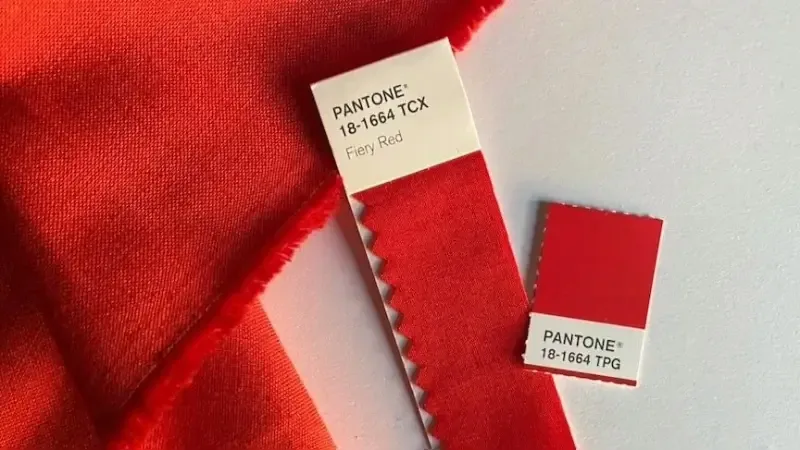
Light reflects differently off porous cotton than it does off coated paper. To achieve a cohesive product, specifications must align with the material substrate.
- TCX (Textile Cotton eXtension): Specify this for dyed soft goods (cotton, fleece, denim, blends). The cotton swatch accounts for dye absorption and weave texture.
- TPG (Textile Paper - Green): Specify this for hard components (zippers, buttons, buckles, coated trims). The lacquer-on-paper reference mimics the smooth surface of hard goods better than fabric.
- The Hybrid Rule: For a monochromatic garment, provide a TCX code for the shell fabric and a TPG reference for the trims. Do not force a button factory to match a cotton swatch; the textural difference often causes a visual mismatch.
4) The Lab Dip Process
The lab dip is the “rough draft” of the fabric color. Managing this phase correctly minimizes color fastness issues and dye migration risks.
- Define Target: Record the exact code and suffix (e.g., 19-4052 TCX).
- Spec the Pack: In the Tech Pack, write: “Target: [CODE]. Visual approval required under D65. Submit 2 options.”
- Mill Execution: The mill dyes 4x4 inch swatches.
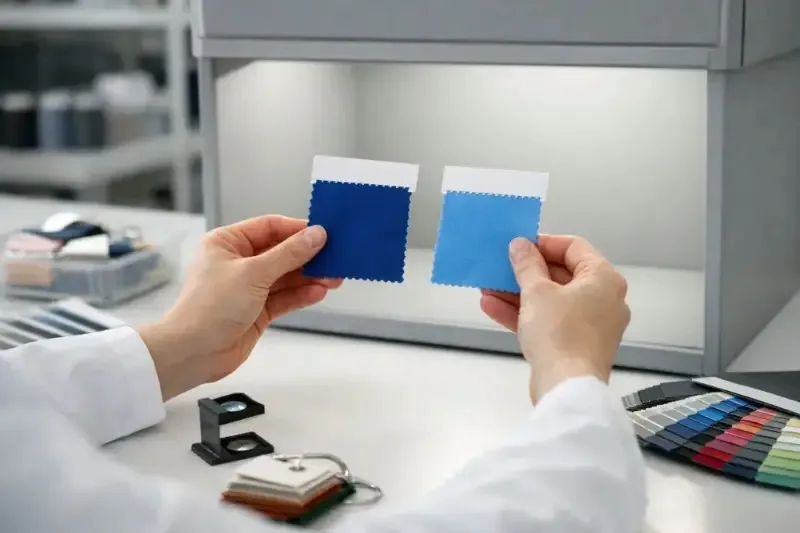
- D65 Review: Review the submission in a Light Booth set to D65 (Artificial Daylight). Standard office lighting creates “color inconstancy,” where shades shift appearance based on the light source.
- Metamerism Check: Toggle the booth to “Store Light” (TL84) or “Home Light” (Incandescent). If the match holds under D65 but shifts drastically under TL84, the dye recipe is unstable (metameric). Reject the submission.
- Approval: Mark the approved swatch, cut it in half, and return one half to the factory as the “Master Standard.”
5) Objective QC: Delta E (dE00)
Visual approval is subjective; Delta E (dE) is objective. It is a mathematical calculation of the distance between two colors in a 3D space. Specifying a dE tolerance protects the brand from disputes.
- The Formula: Request CIEDE2000 (dE00). This formula aligns most closely with human visual perception.
- Commercial Tolerances:
- dE00 ≤ 1.0: Precision Match (Required for separates/suits).
- dE00 ≤ 2.0: Commercial Match (Standard for streetwear/knitwear).
- dE00 > 3.0: Reject (Visible difference to the untrained eye).
Requiring a Spectrophotometer Report with bulk shipments forces the factory to measure the fabric electronically. For detailed standards, refer to the International Commission on Illumination (CIE) or X-Rite’s guide on Delta E.
6) Mini Template: Tech Pack Color Callout
Insert this block into the Bill of Materials (BOM) to standardize requests.
| Parameter | Specification |
|---|---|
| Color Name | Midnight Navy |
| Pantone Code | 19-4052 TCX (Cotton) |
| Component | Shell Fabric (350gsm Fleece) |
| Approval Method | Visual (D65 Light Booth) + Digital (dE00) |
| Tolerance | dE00 ≤ 1.5 |
| Finish Notes | Enzyme Wash |
🧠 Expert Insight: When selecting core colors that must appeal to mass markets—such as what is the most common clothing color for a specific region—always secure the physical swatch before finalizing the BOM. Screens vary; physical standards do not.
Key Benefits: The ROI of Precision Color Control
Adopting a Pantone workflow is a financial strategy, not just a design choice. For private label brands, the cost of “guessing” is prohibitive. Using the Fashion, Home + Interiors (FHI) system transforms color from a subjective opinion into a measurable, enforceable manufacturing standard.
Eliminates Costly Production Errors
Factory “guesswork” based on digital screens is the primary cause of rejected bulk lots. Without a physical TCX swatch, shade variation is inevitable. Anchoring your tech pack to a specific Pantone code eliminates the “monitor vs. reality” gap.
The Impact: Standardizing color specs prevents re-dyeing, which can consume over 30% of the total production budget and delay launches by weeks.
Unifies Brand Identity Across Lines
Customer trust relies on consistency. If your best colors for hoodies do not perfectly match the ribbed cuffs or the t-shirt color combinations in the same drop, the collection appears accidental.
- The Mechanism: Pantone recipes adjust for different substrates. This ensures the dye formula for a cotton tee matches the formula for a poly-blend drawcord.
- The ROI: Precise matching reduces e-commerce returns categorized as “item not as pictured,” protecting your profit margins.
Accelerates Lab Dip Approvals
Subjective feedback like “make it less muddy” creates endless revision loops. Utilizing Pantone allows for Numeric QC. By combining visual checks under D65 lighting with spectral data, approvals become binary.
The Standard: Adhering to AATCC evaluation procedures allows you to set objective tolerances (e.g., Delta E < 1.0), reducing approval timelines by 40%.
Optimizes Tool Investment
New brands often overspend on the wrong tools. Smart purchasing requires aligning the guide with your production stage.
Decision Matrix: Which Guide Do You Need?
| If you are developing… | You need… | Why? |
|---|---|---|
| Dyed Fabrics (Cotton, Fleece) | TCX Cotton Cards | Mimics dye absorption; essential for lab dip approvals. |
| Hard Goods (Buttons, Trims) | TPG Paper Guide | Best for coated surfaces and palette planning. |
| Budget / Student Work | Cotton Passport | Portable and affordable; best for initial selection. |
Need a factory that speaks the language of color? If you want a production team that executes your Pantone specs with precise lab dips, controlled lighting, and QC reporting. 👉 Get a Quote for Your Collection
Challenges & Limitations: The Reality Check

While Pantone provides a universal language for color, it does not bypass the laws of physics or supply chain logistics. Relying solely on a code without accounting for substrate behavior is a primary cause of production delays.
Limitation 1: Codes Are Not Material-Agnostic
A standard like 19-4052 TCX is a target, not a guarantee. The final visual appearance relies heavily on the substrate. A dye recipe that works on flat poplin may look dull or shifted on a ribbed knit or velvet due to light refraction and fiber absorption.
🛡️ Mitigation: Never skip the Lab Dip. The code sets the target; the lab dip proves execution on the actual production fabric.
Limitation 2: Metamerism (The Lighting Trap)
Metamerism occurs when two samples appear to match under factory fluorescence but clash violently in natural daylight. This optical phenomenon happens when dye formulas lack stability across the light spectrum.
⚠️ Critical Warning: Mandate approvals under D65 (Artificial Daylight) and a secondary source (like TL84). If the shade shifts between sources, the dye recipe is chemically unstable.
Limitation 3: The TCX vs. TPG Mismatch
Specifying TPG (Paper) codes for dyed textiles is a fundamental error. TPG is lacquer-on-paper; it lacks the texture and depth of TCX (Cotton). Forcing a mill to match a flat paper chip to a textured towel inevitably results in a “flat” or mismatched aesthetic.
Limitation 4: Physical Reference Drift
Pantone guides are physical objects subject to photodegradation and handling oils. A designer using a 2019 guide will see a different hue than a factory using a 2024 edition. Technical audits suggest replacing guides every 12–18 months to prevent drift.
Limitation 5: The Cost of Precision
Precision costs time. Every round of lab dip revisions adds 5–7 days to the production timeline. Factories often limit “free” revisions to two rounds before charging surcharges.
⚖️ The Trade-off: Enforcing a strict Delta-E (<1.0 dE) tolerance ensures accuracy but dramatically increases the risk of timeline slippage.
Conclusion
Ultimately, the Pantone FHI system is not about aesthetics; it is about risk mitigation. Successful manufacturing requires treating color as a fixed coordinate rather than a subjective preference.
While the Benefits of a standardized palette include brand consistency and reduced returns, the Challenges of metamerism and substrate physics demand a rigorous technical approach.
Next Steps
Translating a palette into a production-ready blueprint requires more than a good eye—it requires a disciplined supply chain partner.
Need help translating your Pantone palette into a production-ready tech pack, lab dip plan, and QC workflow? Contact LeelineApparel here to start your project.
