
Table of Contents
Two brands buy the same heavyweight hoodie for $12 FOB. One scales. The other folds.
The difference isn’t marketing. It is the invisible accumulation of logistics, taxes, and compliance fees that distort the unit price before inventory ever reaches the warehouse.
A landed cost calculator serves as the financial safeguard against these surprises. It aggregates variable expenses, such as freight allocation, insurance, and customs duties, to reveal the true cost per unit.
Sourcing without this data is gambling. Complex fiber blends often trigger specific duty rates in the Harmonized Tariff Schedule, while trade measures like Section 301 can add 25% to the invoice overnight. Mastering this calculation allows founders to negotiate better Incoterms and set retail prices that protect margins.
This post breaks down the math required to price profitably on Shopify or Amazon. We cover the total landed cost formula, the liability shift between CIF and FOB, and a real-world breakdown for a 1,000-unit apparel order.

What is a Landed Cost Calculator?
Landed cost is the total expense incurred to move a product from the factory floor to a sellable location. This includes the manufacturing price plus every fee required to legally import and transport the goods to a warehouse, 3PL, or Amazon FBA center.
A landed cost calculator is a tool that aggregates these variable costs to reveal two critical numbers: the total shipment cost and the true margin per unit.
The Canonical Formula
At its simplest, the calculation follows this structure:
Total Landed Cost (TLC) = Product Cost + Freight + Duties & Taxes + Insurance + Overhead
Apparel sourcing often requires additional line items that generic calculators miss. You must account for sampling amortization, fabric testing (CPSIA), and Quality Control inspections. If you select a custom cut and sew manufacturing model, your base cost structure shifts before shipping even begins.
Why Apparel is Sensitive
In fashion, small details trigger massive cost variances. Duty rates change sharply based on fiber content (e.g., cotton vs. polyester) and construction method (knit vs. woven). A misclassification in the Harmonized Tariff Schedule (HTS) can accidentally double your import tax.
Core Vocabulary
To use a calculator effectively, you must understand the inputs:
- Incoterms (FOB/DDP): International terms that define when liability and cost transfer from the factory to you.
- HTS Code: The 10-digit code used by the U.S. International Trade Commission (USITC) to classify goods and assign duty rates.
- Customs Value: The declared value of goods used to calculate taxes. According to CBP valuation guidance, this is typically the transaction value (price paid), not the retail price.
- MPF and HMF: The Merchandise Processing Fee and Harbor Maintenance Fee are mandatory surcharges for goods entering U.S. ports.
🌍 Real-World Context: A $5.00 t-shirt is never just $5.00. After adding duties (often 16.5%+ for synthetics), freight, and port fees, the “landed” cost typically rises to $7.50 or more.
Core Concepts: How the Landed Cost Engine Works
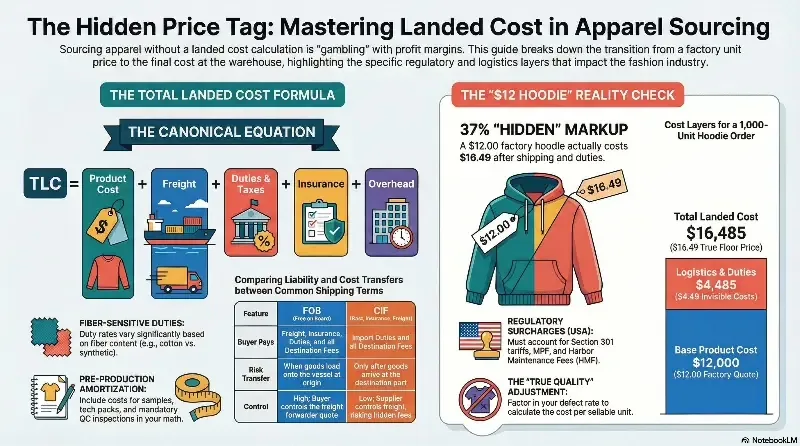
A landed cost calculator is not merely a summation tool; it is a logic engine that aggregates fixed, variable, and regulatory costs. To build an accurate model, you must deconstruct the supply chain into three distinct phases: Acquisition (Factory), Logistics (Movement), and Compliance (Entry).
The mechanism works by layering these costs on top of the base unit price to determine the “floor price”—the absolute minimum amount you must sell the garment for to break even.
1) Input Checklist: Data Collection
Before running the calculation, you must gather specific data points. Missing a single variable (like the Harbor Maintenance Fee) can skew your margin analysis by 2% to 5%.
Product (Factory) Costs
- Unit Price: The quote provided by the manufacturer (usually EXW or FOB).
- Packaging: Costs for polybags, custom hangtags, and branded tissue paper.
- Labels: Woven neck labels, satin care labels, and size tabs.
Pre-production Amortization (Crucial for low MOQ orders)
- Sample Fees: The cost of prototypes (often higher than bulk units).
- Pattern/Tech Pack: Costs for digitizing designs.
- Molds/Tooling: Required for custom hardware like zippers or buttons.
- Compliance Testing: Lab fees for CPSIA (lead/phthalates) or flammability testing.
- Third-Party QC: Costs for inspection agencies to verify quality before shipping.
International Freight & Logistics
- Mode: Ocean (LCL/FCL) vs. Air Freight.
- Surcharges: Peak season surcharges (PSS) or bunker adjustment factors (BAF/Fuel).
- Cargo Insurance: Typically calculated as a percentage of the goods’ value + freight.
Customs & Import Costs (USA)
- Duty Rate: Derived from the HTSUS code.
- Additional Tariffs: Section 301 duties (specifically for China-origin goods).
- Brokerage Fees: Administrative costs for filing the entry.
- MPF (Merchandise Processing Fee): An ad valorem fee for formal entries (0.3464% as of 2024, subject to min/max).
- HMF (Harbor Maintenance Fee): 0.125% fee applicable only to ocean freight entering U.S. ports.
Destination Costs
- Drayage: Trucking cost from the port to the warehouse.
- Terminal Handling Charges: Fees charged by the port for moving containers.
- Domestic Freight: Final mile delivery to a LeelineApparel fulfillment center or Amazon FBA.
2) The Total Landed Cost Formulas
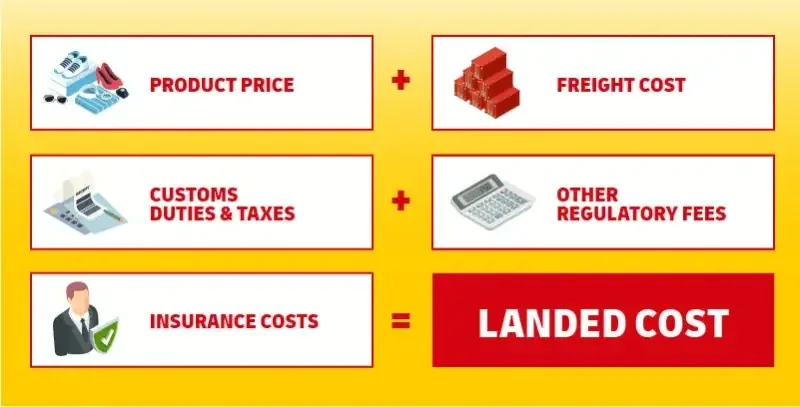
Use these formulas to standardize your pricing model.
The Total Shipment Formula
TLC_shipment = Product_total + Preprod_amortized + Freight_total + Insurance + Duties + Section301 + MPF + HMF + Broker_fees + Port_handling + Domestic_inbound
The Per-Unit Formula
Landed_cost_per_unit = TLC_shipment / Units_received_sellable
The “True Quality” Adjustment: In apparel, not every unit received is sellable. If you operate with a 3% defect rate, your cost per sellable unit increases.
Expected_defect_cost_per_unit = (Defect_rate × Unit_cost) / (1 - Defect_rate)
3) CIF vs. FOB Landed Cost
Your Incoterms determine which data points you input and which ones are “bundled” by the supplier.
| Feature | FOB (Free on Board) | CIF (Cost, Insurance, Freight) |
|---|---|---|
| Supplier Pays | Goods + Export Clearance + Transport to Origin Port. | Goods + Export Clearance + Ocean/Air Freight + Insurance to Destination Port. |
| Buyer Pays | Freight + Insurance + Import Duties + All Destination Fees. | Import Duties + All Destination Fees (Customs, Drayage, Warehousing). |
| Risk Transfer | Transfers to buyer once goods load on the vessel at origin. | Transfers to buyer only after goods arrive at the destination port. |
| Hidden Cost Risk | Low (Buyer controls the freight forwarder quote). | High (Supplier may use cheap freight lines with hidden destination handover fees). |
🔄 Common Misconception: Buyers often assume CIF vs FOB landed cost implies CIF is “all-inclusive.” It is not. CIF covers the water/air transport, but once the ship docks, you are fully liable for brokerage, duties, MPF, and drayage.
4) Common Apparel HS/HTS Codes

Classification drives the duty rate. In the U.S., the difference between a “cotton” shirt and a “synthetic” shirt can be double digits.
Note: Verify all codes using the Official USITC HTS Search Tool before importing.
| Product | Likely Heading | Material | Construction | Pivot Point | Verify Rate |
|---|---|---|---|---|---|
| T-Shirt | 6109 | Cotton | Knit | Cotton is usually ~16.5%; Synthetic is ~32%. | USITC 6109 |
| Activewear Top | 6109 / 6110 | Synthetic | Knit | “Performance” features do not change HTS; fiber weight does. | USITC 6110 |
| Hoodie | 6110 | Cotton | Knit | Cotton vs. Man-made fibers. | USITC 6110 |
| Fleece Hoodie | 6110 | Synthetic | Knit | Polyester often carries higher duties than cotton. | USITC 6110 |
| Pants/Chinos | 6203 / 6204 | Cotton | Woven | Gender and material breakdown (e.g., >50% cotton?). | USITC 6203 |
| Windbreaker | 6201 / 6202 | Synthetic | Woven | Water resistance capability can alter classification. | USITC 6201 |
| China Note | Section 301 | All | N/A | Most China-origin apparel faces an additional tariff (verify current exclusions). | USTR Guidance |
5) USA Duty-Rate Workflow
To get the correct percentage for your calculator, follow this logic flow:
- Define the Garment: Identify gender (Men/Women/Unisex), Construction (Knit vs. Woven), and Fiber content by weight (e.g., 60% Cotton, 40% Poly).
- Locate the Heading: Use the USITC tool. Knits generally fall under Ch 61; Wovens under Ch 62.
- Find the Tariff Line: Drill down to the 8 or 10-digit level based on fiber content.
- Check Origin Tariffs: If sourcing from China, check for Section 301 applicability. If sourcing from Thailand or Cambodia, check for GSP or other treaty eligibility.
- Validate: For high-value orders, request a Binding Ruling from CBP to lock in your rate.
6) Freight Cost Estimator Logic
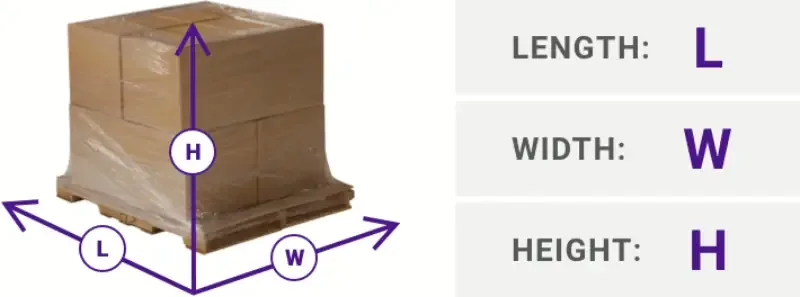
Freight is calculated based on space, not just weight.
Ocean (LCL): Charged by CBM (Cubic Meter).
Ocean_LCL_cost ≈ (Total_CBM × Rate_per_CBM) + Origin_Fees + Destination_Handover_Fees
Air Freight: Charged by the greater of Actual Weight or Dimensional (Volumetric) Weight.
Air_cost ≈ Chargeable_Weight_kg × Rate_per_kg
🧠 Expert Insight: Apparel is voluminous. Puffer jackets and hoodies take up significant space. Vacuum sealing goods at the factory can reduce CBM/Dim weight by 30%, directly lowering freight costs.
7) Real-World Sourcing Scenario
The Case: Importing 1,000 Heavyweight Cotton Hoodies from China to Los Angeles (Sea Freight).
The Inputs:
- FOB Unit Price: $12.00
- Total Product Cost: $12,000
- Shipment Volume: 3.5 CBM (approx. 50 cartons)
- HTS Classification: 6110.20.20 (Cotton Pullover)
- Base Duty Rate: 16.5%
- Section 301 Tariff: Assumed 7.5% (Check current rates)
The Cost Breakdown (Estimates):
- Product Cost: $12,000
- Ocean Freight (LCL): ~$600 (Market dependent)
- Cargo Insurance: $50
- Customs Duties (16.5%): $1,980
- Section 301 Tariff (7.5%): $900
- MPF (Min/Max applies): ~$40 (Estimated)
- HMF (0.125% of value): $15
- Brokerage Fee: $150
- Dest. Handling/Drayage: $450
- Domestic Freight (LA to Warehouse): $300
The “Hidden Fee” Reveal:
- Total Landed Cost: $16,485
- Landed Unit Cost: $16.49
The Analysis: The FOB price was $12.00. The landed price is $16.49. That is a 37% markup purely from logistics and compliance. If you priced this hoodie based on a $12 cost, you would likely bleed money on every sale after marketing expenses.
Conclusion
In apparel sourcing, the FOB price is merely the starting line. True profitability is determined by the “floor price”—the final sum of fiber-specific HTS duties, freight volatility, and non-negotiable port fees. A brand that prices based on factory quotes alone is gambling with its liquidity.
Next Steps: Build Your Calculator
Stop guessing and start calculating. Build a dynamic costing sheet that includes:
- An HTS Lookup Column: Link directly to the USITC database for quick verification.
- Fee Logic: Columns for MPF (Merchandise Processing Fee) and HMF.
- Freight Estimator: A toggle for Air vs. Ocean rates based on current lane data.
- Margin Safety: A calculator tab that subtracts landed costs from your retail price.
- Validation: A “last updated” date field to track tariff changes.
Need help validating a landed cost estimate (DDP vs FOB, duty assumptions, and freight options)? Contact LeelineApparel.
