
Table of Contents
I have seen retailers reject entire shipments because the brand owner held a generic factory certificate rather than a shipment-specific document. A supplier’s PDF claim is worthless without chain-of-custody proof. If you cannot trace the fiber from the farm to your warehouse, you are holding a legal liability.
GOTS certified clothing is apparel produced with at least 70% certified organic fibers under verified environmental and social standards.
We will detail the Version 8.0 updates regarding GMO screening and non-deforestation. You will also learn the critical distinction between Scope Certificates (SC) and Transaction Certificates (TC). This guide outlines the exact verification workflow we use to protect our clients.
Here is how to secure your organic inventory.
- What is GOTS Certified Clothing?
- 1) The Chain-of-Custody Model (Input ➔ Output)
- 2) Scope Certificate (SC) vs. Transaction Certificate (TC)
- 3) The Transaction Certificate Workflow
- 4) Version 8.0 (2026 Release)
- 5) Chemicals & Dyes: Input Stream Management
- 6) When You Need Certification
- Final Verdict
What is GOTS Certified Clothing?
GOTS certified clothing refers to finished garments that meet the Global Organic Textile Standard—the world’s leading processing rulebook for organic fibers.
It is important to distinguish between farming and processing. Organic farming certification stops the moment the cotton is harvested. GOTS picks up post-harvest (spinning, knitting, dyeing, and assembly). It acts as a strict chain of custody, ensuring that clean raw materials are not contaminated by toxic bleaches or heavy metals during manufacturing.
In our supply chain, we treat GOTS as a “building code” for textiles. It verifies organic fiber integrity, enforces restricted chemical inputs, and unlike many other standards, mandates strict social criteria (labor rights).
The Two Label Grades
When sourcing or designing, you will encounter two specific label grades based on fiber composition:
- “Organic”: The product must contain a minimum of 95% certified organic fibers.
- “Made with Organic Materials”: The product must contain at least 70% organic fibers. This grade allows us to blend strictly regulated synthetics (like elastane) to create performance activewear that still meets the standard.
Common Misconceptions
A frequent sourcing error is assuming GOTS means “chemical-free.” It does not. Instead, it relies on controlled inputs. As defined by the official GOTS standard criteria, the standard bans hazardous substances (like formaldehyde and azo dyes) but allows specific, biodegradable chemical additives necessary for colorfastness and durability.
Quick Sourcing Terminology
- Certified Entity: The factory or brand holding the certification.
- Scope Certificate (SC): Proves a supplier is capable and licensed to produce GOTS goods.
- Transaction Certificate (TC): The specific document proving your specific batch of goods is certified.
- License Number: The unique ID used to verify a supplier in the public GOTS database.
💡 Key Insight: GOTS is currently the only major standard that simultaneously audits environmental compliance and social welfare (living wages and safety) in the same certification.
1) The Chain-of-Custody Model (Input ➔ Output)
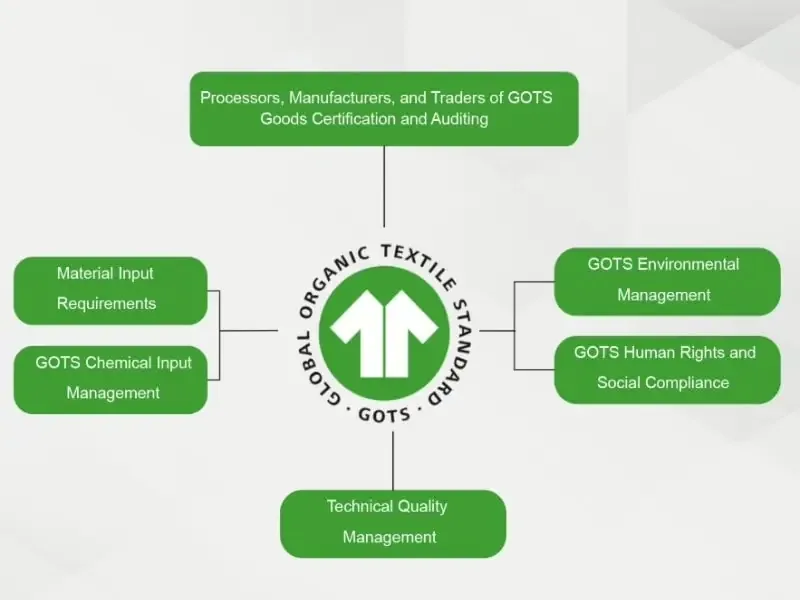
Traceability in organic textiles operates like a relay race. A physical “baton”—the Transaction Certificate—must pass between every facility that alters the product. If one facility drops the baton, the “organic” status invalidates immediately.
The material flows through this verified sequence:
Farm ➔ Gin ➔ Spinner ➔ Fabric Mill ➔ Dyehouse ➔ Cut & Sew ➔ Trader ➔ Brand
Textiles face high fraud risks because organic cotton visually resembles conventional cotton. Without strict audits, factories can blend cheaper, conventional fibers during the spinning phase. We prevent this using Volume Reconciliation: if a spinner buys 1,000kg of raw organic cotton, they cannot legally sell 1,100kg of organic yarn. The math must balance.
2) Scope Certificate (SC) vs. Transaction Certificate (TC)
Importers often lose money by confusing these two documents. You must distinguish between facility eligibility and product verification.
- The Scope Certificate (SC): Proves a facility is licensed to produce GOTS goods. Think of this as a “Driver’s License”—it shows the factory can drive, but it does not prove they drove your specific car.
- The Transaction Certificate (TC): Proves a specific shipment allows for organic claims. This is the “Bus Ticket” for your goods. It tracks exact lot numbers and weights from the seller to you.
⚠️ Critical Logic: An SC without a matching TC is worthless. You cannot legally label a product “Organic” based solely on a factory’s Scope Certificate.
3) The Transaction Certificate Workflow
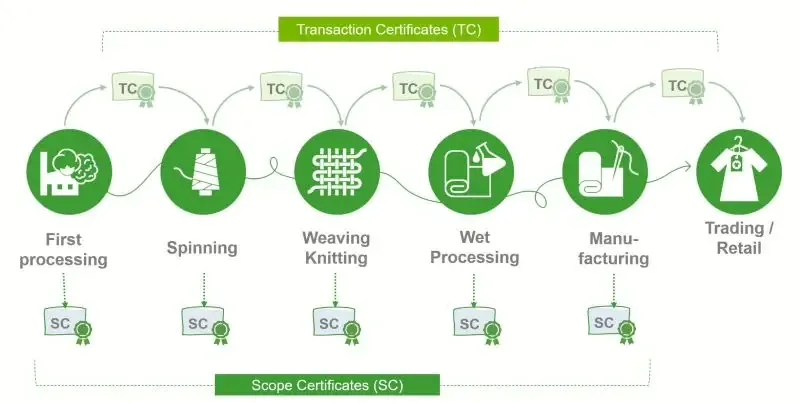
We execute this protocol to ensure the paper trail survives the manufacturing process.
- Entity Validation: Before sampling, we verify the supplier’s license number in the GOTS Public Database.
- BOM Alignment: We align the Bill of Materials with certifiable components. Every button, thread, and zipper must meet GOTS residue standards.
- Production Segregation: The factory isolates organic lots from conventional runs to prevent fiber contamination.
- TC Application: Once the goods ship, the supplier applies for the TC with their Certification Body.
- Data Reconciliation: We cross-reference the draft TC against the Packing List and Bill of Lading. The Gross Weight and Product Description must match exactly. A discrepancy of even 1kg can stall customs clearance.
- Archival: We store the SC and TC per SKU to satisfy future retailer audits.
4) Version 8.0 (2026 Release)
GOTS is dynamic. Version 8.0 releases in March 2026 and becomes effective 1 March 2027. We are adjusting our compliance protocols now to address two upcoming shifts:
- DNA-Based GMO Screening: The new standard demands stricter quantitative testing for cotton DNA. We will require ISO-accredited lab reports at the ginning stage to catch GMO contamination early.
- Deforestation-Free Claims: Buyers must prove raw fibers did not contribute to deforestation. This requires GPS-level data from the farm, aligning with new EU regulations.
🧠 Implementation Tip: If you are designing clothing manufacturing costs and hangtags for late 2026, reference the effective date to avoid printing obsolete packaging.
5) Chemicals & Dyes: Input Stream Management
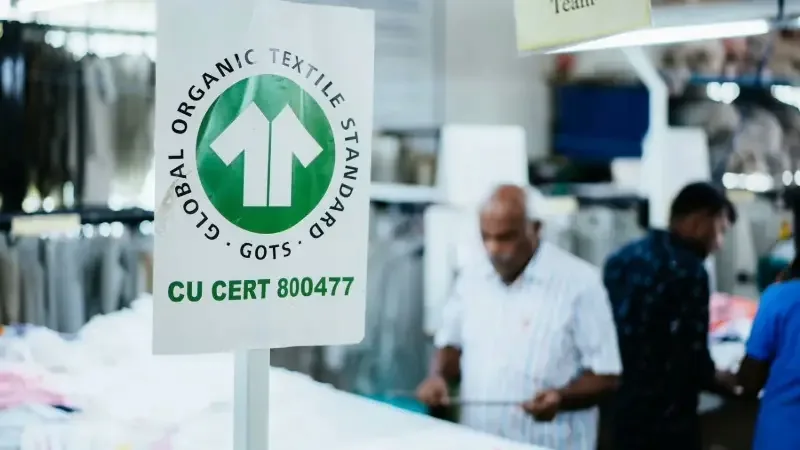
“Non-toxic” is vague; GOTS relies on a strict Positive List of approved chemical inputs. We do not just test the final shirt; we audit the dye house inventory.
- Prohibited: Azo dyes (releasing carcinogenic amines), heavy metals, and chlorine bleaches.
- Allowed: Oxygen-based bleaches and low-impact reactive dyes.
We verify that all auxiliaries (softeners, detergents) appear on the GOTS Approved Inputs list.
6) When You Need Certification
Many brands assume only the factory needs certification. This is false. If you break the seal, you break the chain.
- Certified Entity: If you repackage goods, apply new labels, or split bulk shipments (e.g., at an Amazon FBA prep center), you technically manipulate the product. You must hold your own Scope Certificate to maintain the claim.
- Exempt Entity: If you receive finished, sealed products and sell them to the end consumer without altering the packaging, you generally remain exempt.
Understanding Incoterms and where the chain of custody transfers is vital to keeping your organic claims legal.
Why GOTS Matters: Risk Mitigation & ROI
Sourcing GOTS certified clothing is a strategic defense against greenwashing litigation and supply chain opacity. We treat certification as a compliance asset, not just a marketing sticker.
Here is how verified compliance translates into commercial value:
1. Defensible Anti-Greenwashing Proof
Regulators in the EU and US are cracking down on generic “organic” claims. We provide a Scope Certificate (SC) and per-shipment Transaction Certificate (TC) to create a legal firewall. This documentation satisfies strict retailer audits and validates your product for premium marketplaces.
2. Proactive Chemical Controls
While OEKO-TEX Standard 100 tests finished goods for residue, GOTS restricts hazardous inputs—like heavy metals and formaldehyde—at the dye house level. This “input control” eliminates toxicity risks at the source, preventing costly recalls for sensitive items like babywear or custom t-shirts.
3. Audited Ethical Production
Social compliance is often vague; GOTS makes it measurable. The standard mandates audits for safe working conditions and living wages, aligning your supply chain with OECD Due Diligence Guidance. This provides the substantiated data needed for ESG reporting on corporate uniforms.
4. Commercial Velocity
Certification reduces friction. For entrepreneurs, the GOTS v8.0 Standard logo increases on-page conversion by silencing customer skepticism. For procurement officers, it fast-tracks internal approvals by providing verified, third-party proof of sustainability.
Final Verdict
Ultimately, GOTS certification represents the difference between a marketing gimmick and a verified asset. While the administrative rigor—specifically ensuring every supplier holds a valid Scope Certificate (SC) while providing a shipment-specific Transaction Certificate (TC)—creates operational friction, it is the only defensible shield against modern greenwashing litigation.
As Version 8.0 (effective March 2027) introduces strict DNA screening and non-deforestation mandates, the era of self-regulation is over. You must audit your supply chain now to prevent liability later.
Final Buyer Checklist
Use this protocol to validate every organic order before you pay the deposit:
- ✅ Verify the License: Confirm the supplier’s status in the public database.
- ✅ Check the Scope: Ensure the certificate explicitly covers your specific product category (e.g., “Garments,” not just “Fabrics”).
- ✅ Demand the TC: Collect the facility SC and the per-shipment TC.
- ✅ Audit the Data: Match the TC weight and lot numbers to your Incoterms documentation, invoice, and Bill of Lading.
- ✅ Layer Protection: Decide whether to add OEKO-TEX Standard 100 for finished-goods quality assurance.
Next Steps
If you are building a certified supply chain and want a manufacturing partner, we can help. Contact LeelineApparel Here.
