Sourcing the best Turkish towel manufacturer means verifying capabilities beyond a simple catalog. Whether you need wholesale Turkish towels or private label peshtemal, your partner must demonstrate export readiness and compliance with global OEKO-TEX textile standards.
Ignore fixed online prices. True B2B quotes depend entirely on your GSM, fiber blend, and customization specs. Use this guide to shortlist factories that deliver operational reliability.

Table of Contents
List of Turkish Towel Manufacturers
| Company Name | Founded Year | Key Features | Target Market | Signature Product |
|---|---|---|---|---|
| The Turkish Towel Company | 1998 | Known for high-end luxury towels used in hotels and spas. | Hospitality (B2B) & Luxury Consumers (B2C) | “Hotel Collection” Plush Bath Towels |
| Classic Turkish Towels | Est. 2015 | Offers a massive variety of towel sets, bathrobes, and bath mats at affordable price points. | Mass Market & E-commerce Shoppers | Value-Pack 6-Piece Towel Sets |
| MTC Linen | 1978 | They specialize in custom manufacturing (OEM) for hotels, hospitals, and promotional brands. | B2B (Wholesalers, Hotels, Brands) | Custom Logo-Embroidered Hotel Towels |
| Towelmed | 2007 | A manufacturer specializing in high-quality textile production, including bamboo, cotton, and modal blends. | B2B, Private Label Brands, & Wholesalers | Bamboo & Cotton Blend Towels |
| Anza Textile Company | 1970s (Family Roots) | Focuses on Peshtemal (traditional flat-woven towels), blankets, and robes. | Boutique Stores, Wholesalers, Promotional Gifts | Traditional Fringed Peshtemals |
| American Soft Linen | 2016 | They offer good quality standard bath towel sets in many colors for home use. | Mass Market & Amazon/E-commerce | Premium Turkish Cotton Bath Sheets |
| Turkish Waffle Towel | 2019 | Specifically specializes in waffle-weave textured towels. | Niche Consumers & Modern Home Decor | Honeycomb Weave Robes & Towels |
| Jennifer’s Hamam | 2009 | They are dedicated to preserving the art of “looped” and hand-loomed weaving on old-style shuttles. | High-end Tourists & Artisanal Textile Collectors | Hand-Loomed Organic Cotton Wraps |
| Peshtemal Concept | 2018 | A manufacturer focused almost exclusively on Turkish Peshtemals (Fouta towels). | Beach Shops, Corporate Gifts, & Wholesalers | Custom Patterned Beach Foutas |
| Laguna Beach Textile Co. | 2015 | An American brand styling their products with a California beach vibe, but sourcing authentic manufacturing from Turkey. | Beach Goers, Outdoor Lifestyle, & Home Decor | “Cabana” Stripe Beach Towels |
Top 10 Turkish Towel Manufacturers
1. The Turkish Towel Company

The Turkish Towel Company targets the premium boutique market. They specialize in quick-dry peshtemal (hamam) and high-end terry options. This mix fits small-to-mid wholesale buyers needing shelf-ready aesthetics—think spa-quality absorbency and intricate fringe details—without massive volume requirements.
Private Label & Customization Checklist
Verify these specs to secure your brand identity:
- Logo placement: Confirm options for sewn-in woven labels versus direct embroidery.
- Pattern durability: Ensure designs are woven into the fabric (Jacquard) rather than printed. Woven patterns resist fading and look significantly more expensive.
- Packaging: Ask for custom hangtags and branded polybags to elevate the unboxing experience.
Commercial Questions to Ask (Quote-Ready)
Copy-paste these queries to get an accurate B2B quote:
- MOQ by SKU: What are the minimums for stock items versus custom colorways?
- Sampling: What is the cost and timeline for a custom prototype?
- Lead times: What is the production range for bulk orders (e.g., 500+ units)?
- Compliance: Can you provide current OEKO-TEX Standard 100 or GOTS certificates to verify organic claims?
- Quality Control: What is your Acceptable Quality Limit (AQL) target for final inspections?
2. Classic Turkish Towels

Hotel buyers and Amazon FBA sellers cannot afford “batch drift.” Classic Turkish Towels serves this market by prioritizing stable specs over fast fashion. They are your best bet for standard terry, peshtemal, or waffle weaves that must remain identical across every reorder.
Spec Details to Lock Early
Prevent negative reviews by defining these limits in your contract:
- Dimensions & Weight: Set exact cut sizes and GSM targets (e.g., 600 GSM for luxury bath, 280 GSM for peshtemal).
- Performance: Demand ISO 105 colorfastness ratings (Grade 4+) and strictly enforced shrinkage limits (<5%) for industrial laundering.
- Construction: Specify loop height for terry or warp tightness for flat weaves.
The Operational Reorder Plan
Structure your supply chain around a signed “golden sample.” Keep this master unit at your HQ to physically benchmark every incoming shipment. Before wiring funds, require a Proforma Invoice that explicitly lists Incoterms, HS Codes, and carton pack-out dimensions. You need this specific data to calculate accurate landed costs and prevent FBA warehouse rejection.
🚀 Actionable Insight: Request “lab dips” for every colorway in your initial tech pack. Approve these physically under different lighting conditions (daylight vs. indoor) to ensure your navy blue doesn’t look black in a hotel bathroom.
3. MTC Linen

Sourcing for a 200-room property requires guaranteed capacity and strict uniformity. MTC Linen specializes in this high-volume tier, allowing procurement managers to outfit entire hotels—from bathrobes to sheets—in single container loads.
Customization for hospitality
Hotels operate on margins and durability. Focus your technical pack on these specs:
- GSM Tiers: Specify 600+ GSM for executive suites and 400–450 GSM for high-turnover pool towels to balance luxury with laundry costs.
- Dobby Borders: Use standard dobby borders. They offer premium branding at lower costs than custom jacquard weaves.
- Color Control: Define an optical white standard. New batches must match existing inventory even after industrial bleaching cycles.
Risk controls & QC
High volume increases financial risk. Protect your budget with these controls:
- Written QC Plan: Attach an AQL (Acceptable Quality Limit) table to your PO. Standard hotel contracts use AQL 2.5 for major defects.
- Verify Certificates: Demand specific license numbers. Verify validity via the OEKO-TEX Label Check rather than accepting marketing logos.
- Defect Policy: Define remedies before paying deposits. If 3% of units fail inspection, establish in writing if the factory credits you or ships replacements.
4. Towelmed

Towelmed manufactures inventory specifically for clinics, hospitals, and high-volume spas. They specialize in high-density terry and waffle weaves in bleach-safe solids. Branding is strictly functional: durable embroidery or woven labels designed to survive repeated industrial washing.
Performance Spec Checklist
Institutional buyers must prioritize lifespan and hygiene over luxury softness. Verify these metrics before approving a purchase order:
- Bleach Resistance: Ensure white textiles use indanthrene (vat) dyes to withstand chlorine and peroxide without yellowing.
- Linting Control: Require “low-lint” test reports. Excess fibers can contaminate sterile environments and clog air filtration systems.
- Commercial GSM: Target 400–500 GSM. Heavier towels drastically increase energy costs during drying and often violate TRSA commercial laundry guidelines.
Commercial Questions to Ask
Procurement teams need to filter out retail-grade suppliers immediately. Use this inquiry list to validate capabilities:
- Custom vs. Stock MOQ: What is the minimum order for custom embroidery versus plain stock inventory?
- Documentation: Can you provide a verifiable OEKO-TEX Standard 100 certificate number to prove chemical safety?
- Lead Times: What is the specific lead time for pre-production samples versus the final bulk shipment?
5. Anza Textile Company

Anza Textile Company supports brands that prioritize variety and frequent collection refreshes over sheer volume. They specialize in mixed assortments, allowing you to source standard cotton, bamboo blends, and complex jacquard weaves in a single order. This flexibility lets you execute seasonal “drops” to keep your storefront fresh without committing to thousands of identical units.
Customization Depth
Precise design details justify premium pricing. Always specify yarn-dyed construction (threads dyed before weaving) rather than surface printing to ensure patterns withstand washing. To avoid “color drift” during production, enforce these briefing rules:
- Solids: Request lab dips to approve the exact dye shade.
- Prints: Demand strike-offs to check design clarity.
- References: Map colors to Pantone TCX codes, not vague descriptions like “ocean blue.”
Due Diligence
Don’t trust; verify. Validate their OEKO-TEX Standard 100 or GOTS status by entering their license number into the official database. In your contract, set a strict Acceptable Quality Limit (AQL) for defects.
6. American Soft Linen

American Soft Linen bridges the gap between Turkish looms and U.S. fulfillment centers. They are the ideal partner for brands that need “retail-ready” inventory without hiring a costly third-party prep center.
Copy this checklist for your RFQ:
- Materials: Specify 100% long-staple Turkish cotton. This fiber length delivers the durability and break strength required by ASTM D5433 standards.
- Sustainability: Do not accept generic “eco-friendly” claims. Request valid transaction certificates for any organic or recycled material claims.
- Validation: Never order bulk without a “Golden Sample.” Test this unit specifically for drying speed, absorbency, and lint shedding after three wash cycles.
⚡ Power Move: Email your specific Amazon FNSKU barcode PDF with your purchase order. Negotiate for the factory to apply these stickers during packing. This simple step saves you roughly $0.20–$0.50 per unit in domestic prep labor.
7. turkishwaffletowel.com

Its honeycomb structure traps air without adding bulk, occupying half the shelf space of standard terry towels. This makes turkishwaffletowel.com the strategic choice for FBA sellers and travel boutiques managing strict storage fees and shipping weights.
Spec Essentials: Controlling the Shrink
Waffle fabric shrinks significantly more than standard terry. You must define technical limits in your tech pack to prevent customers from receiving towels that shrink to “child size” after one wash.
- GSM Targets: Aim for 220–260 GSM for robes and 280–320 GSM for towels. Heavier weights lose the quick-dry advantage.
- Shrinkage Tolerance: Standard waffle shrinks 10–15% if untreated. Demand pre-washed fabric with a contract guarantee of <5% dimensional stability per ISO 5077 standards.
- Snag Resistance: Request a high-tension weave. Loose waffles catch on jewelry and unravel easily.
Brandability & Packaging
- Packaging: Use minimal belly bands highlighting “Sand-Free” or “Travel-Ready” benefits. Avoid plastic polybags.
- Labels: Specify soft satin tags. Waffle texture is initially rougher, so scratchy woven labels ruin the hand-feel.
8. Jennifer’s Hamam

Jennifer’s Hamam bridges the gap between artisanal appeal and industrial reliability. They are the ideal source for flat-woven, tasseled towels suited for high-end boutique retail and spa gifting.
Customization & Specs
You must standardize the “handmade” aesthetic to minimize returns.
- Finishing: Choose hand-tied tassels for high-margin gift sets or machine-twisted ends for high-turnover spa use.
- Color: Insist on yarn-dyed fabrics. Unlike cheap prints, the pattern is woven into the structure and won’t fade.
- Labels: Stitch woven brand tags on the side hems. Never place them near the fringe where they snag and unravel.
Buyer Controls
Artisanal sourcing often suffers from sizing drift. Define a strict ±3% tolerance for weight and dimensions to ensure shelf stackability. Use ISO 2859-1 (AQL) standards to clearly distinguish between acceptable “character” (minor slubs) and rejectable defects. Verify all eco-claims against current GOTS database records before wiring a deposit.
9. Peshtemal Concept

Standard terry towels kill margins because they are bulky. You end up paying to ship air. Peshtemals (flat-woven Turkish towels) solve this logistics problem.
They fold completely flat. This makes them the perfect high-margin SKU for Amazon FBA sellers and resort boutiques with limited shelf space. They dry quickly, reduce laundry energy costs, and carry high perceived value as a premium travel product.
Spec Sheet Must-Haves
A cheap peshtemal feels like a tablecloth. Prevent returns by controlling these strict specs:
- Dimensions: Standard resort size is 100cm x 180cm (39″ x 71″).
- Weight: Target 280–320 GSM. Lighter feels cheap; heavier loses the travel advantage.
- Fringe: Demand hand-knotted tassels. Machine-cut fringe unravels after one wash.
- Weave: Require yarn-dyed threads. Printed patterns fade; woven stripes do not.
Commercial Checklist
- MOQ: Stock colors start at 50 units. Custom stripes require 200–300 units per colorway.
- Lead Time: Allow 20–30 days for custom weaving.
- Testing: Cotton shrinks. Demand an ISO 5077 report verifying <6% shrinkage before you approve the bulk shipment.
- Packaging: Use paper belly bands, not boxes. This keeps your fulfillment fees in the lowest tier.
10. Laguna Beach Textile Company

Laguna Beach Textile Company specializes in these critical seasonal drops, handling high-vibrancy SKUs that must withstand sun, salt, and chlorine.
Design-to-production specs
You must balance visual detail against durability.
- Jacquard Woven: The pattern is woven with pre-dyed yarns rather than printed on top. This prevents peeling and fading but restricts you to fewer colors.
- Printed Velour: Essential for photo-realistic branding or complex gradients. Always demand a physical strike-off to check resolution before approving bulk runs.
- Color Control: “Navy blue” is subjective. Use specific Pantone TCX codes to anchor your color specs.
Launch planning
Do not guess your schedule. Build your timeline backward from your summer launch date.
- Sampling: 15–20 days (add 10 days for revisions).
- Production: 30–50 days.
- Freight: 30–45 days via Ocean.
🚀 Actionable Insight: Cheap reactive dyes fade to grey after one week in the sun. Mandate Grade 4 UV resistance in your contract and require an AATCC 16 lightfastness lab report to prove it.
5-Step Execution Playbook for Sourcing Towels
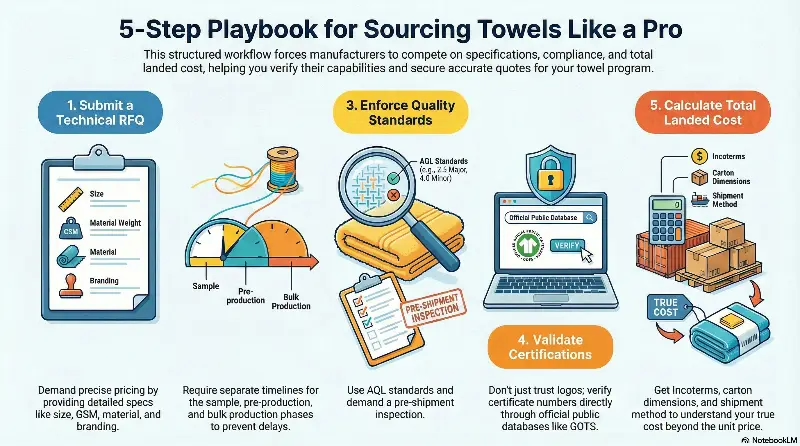
Stop sending generic emails. Factories ignore vague requests. Use this structured workflow to force manufacturers to compete on specs, compliance, and total landed cost. Follow these steps to verify capabilities and secure accurate quotes.
Step 1: Submit a Technical RFQ
Factory representatives prioritize buyers who speak their language. Copy and paste this template to demand precise pricing. Ensure you specify the correct types of towels (e.g., Peshtemal vs. Terry) to avoid quoting errors.
Subject: RFQ for [Company Name] – Towel Program
Specs:
- Type: [e.g., Peshtemal / Terry / Waffle]
- Size: [e.g., 100cm x 180cm]
- Weight: [e.g., 320 GSM]
- Material: 100% Turkish Cotton (Long Staple)
- Color Method: [Yarn-dyed vs. Reactive Print]
- Branding: [Woven Label / Embroidery / Hangtag]
- Packaging: [Belly band / Polybag / Bulk pack]
Requirements:
- Price Tiers: Quote per unit for 100, 500, and 1,000 pieces.
- Sampling: Cost for one custom pre-production sample.
- Timeline: Production lead time for bulk orders.
Step 2: Lock Down Numeric Lead Times
Do not accept a single “delivery date.” Require distinct timelines for three specific phases to prevent delays.
- Sample Lead Time: Days required to create the initial prototype.
- Pre-Production Sample: Days required for the final “Golden Sample” approval.
- Bulk Production: Days required to weave and finish the full order.
Ask for separate Minimum Order Quantities (MOQs) for stock colors versus custom Pantone dye lots. If Turkish lead times exceed your launch schedule, compare these metrics against towel manufacturers in China for speed or Australian towel manufacturers for local logistics.
Step 3: Enforce AQL Quality Standards
Define “defective” clearly in your contract. Reference the ISO 2859-1 standard for statistical sampling. Establish an Acceptable Quality Limit (AQL) of 2.5 for Major defects and 4.0 for Minor defects. List specific rejection criteria:
- Critical: Holes, mold, sharp objects (0 allowed).
- Major: Wrong GSM (±5%), oil stains, skewing (bowing) over 3cm.
- Minor: Loose threads, untrimmed labels.
Demand a pre-shipment inspection. State clearly that you will require a refund or remake if the failure rate exceeds these AQL thresholds.
Step 4: Validate Certification Scopes
Never trust a logo on a website footer. Request the certificate number and the scope document. Verify organic claims directly through the Global Standard (GOTS) Public Database. Confirm the certificate acts as valid proof for your specific product category (e.g., “Grade 1” for baby products).
If a manufacturer cannot validate their compliance documents, explore sourcing alternatives in emerging markets like Cambodia or Thailand, where newer facilities often maintain strict, up-to-date audit trails.
Step 5: Calculate Total Landed Cost
A low unit price often hides high logistics costs. Require these three data points to calculate your true margin:
- Incoterms: Specify FOB (Free on Board) or DDP (Delivered Duty Paid). Refer to the official ICC Incoterms Rules to understand where your liability begins.
- Pack-Out Data: Request exact carton dimensions and gross weights.
- Shipment Method: Clarify if the quote assumes sea freight or air cargo.
Use these numbers to secure an accurate freight quote before paying the deposit.
Ready to start production? Get a Quote
FAQs About Turkish Towel Manufacturers
1. What is a realistic MOQ for wholesale Turkish towels vs. custom private label?
Stock items often start at just 50 units per color. However, custom manufacturing—such as specific Pantone dyeing or jacquard weaving—typically requires 300–500 units per SKU to justify loom setup costs.
For private labeling, ask suppliers if they can sew your custom woven tags onto stock inventory. This strategy keeps your minimums low while still establishing your brand identity.
2. How long do samples and bulk production usually take?
Expect 10–15 days for custom prototyping and 30–50 days for bulk weaving and finishing. Turkish loom scheduling tightens significantly before summer (February–April). Always require the factory to commit to specific “hand-over dates” in the Proforma Invoice (PI) rather than accepting vague estimates like “a few weeks.”
3. What towel type should I source for hotels vs. Amazon FBA?
For hotels, source 600+ GSM double-loop terry towels designed to withstand hundreds of industrial laundry cycles. For Amazon FBA, prioritize 280–320 GSM flat-woven peshtemals. These fold compactly, drastically reducing your FBA storage fees and shipping weight while offering high perceived value to travelers.