
Table of Contents
Sourcing outerwear takes more than just a basic sewing line. You need a partner who handles technical fabrics and heavy-duty trims. While China owns volume, Turkey wins on speed.
However, finding the best jacket manufacturer turkey has to offer remains difficult. We vetted these factories based on zipper quality, EU customs compliance, and sampling workflows. This list helps private labels secure reliable capacity for 2026.
- List of Jacket Manufacturer Turkey
- 1. Akcakaya Textile
- 2. Conbello Textile
- 3. Kledingproductie
- 4. Last Textile
- 5. Sareteks
- 6. Kozanteks Textile
- 7. Desbina Textile
- 8. istanbulclothingmanufacturers
- Your Jacket Sourcing Action Plan: From Sketch to Shipment
- FAQs About Jacket Manufacturer Turkey
List of Jacket Manufacturer Turkey
| Company Name | Location | Core Products | Key Advantage |
|---|---|---|---|
| Akcakaya Textile | Izmir, Turkey | Knitted garments, t-shirts, sweatshirts, eco-friendly wear | Strong focus on sustainability; GOTS certified, ethical production, high-quality organic cotton. |
| Conbello Textile | Istanbul, Turkey | Custom t-shirts, hoodies, polo shirts, activewear | Excellent for Private Label; full customization, high-quality printing/embroidery, corporate wear. |
| Kledingproductie | Netherlands / Turkey | General custom clothing, street fashion, casual wear | Great for EU buyers; full-package production (from design to delivery), flexible MOQs. |
| Last Textile | Istanbul, Turkey | Women’s, men’s, and kids’ ready-to-wear apparel | Comprehensive OEM / ODM services; fast turnaround times, strong fabric sourcing network. |
| Sareteks | Istanbul, Turkey | Knitted apparel, sustainable fashion, loungewear | Vertically integrated capabilities; strong emphasis on quality control and eco-friendly fabrics. |
| Kozanteks Textile | Turkey | Casual wear, sportswear, knitted fabrics | Reliable for high-volume bulk production; competitive pricing, modern manufacturing facilities. |
| Desbina Textile | Istanbul, Turkey | Woven and knitted fashion garments, trendy wear | End-to-end service; strong in pattern making and sampling, adaptable to fast-fashion trends. |
| Istanbul Clothing Manufacturers | Istanbul, Turkey | Wide variety of garments (acts as a network/hub) | Access to a wide supplier network; ideal for finding specialized factories for specific apparel needs. |
1. Akcakaya Textile
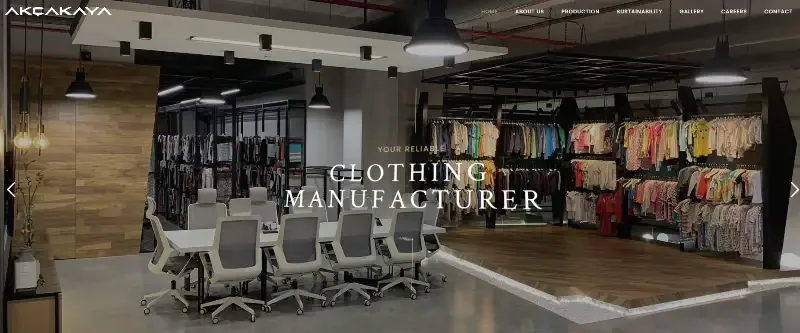
Akcakaya operates in Izmir and specializes in scaling production from initial prototypes to full export containers. For jacket buyers, I found they offer a rare mix of knit flexibility and outerwear technicality. They understand that a bomber jacket requires significantly stricter QC protocols for zipper waviness and lining tension than a standard hoodie.
Fit Check: This manufacturer suits brands graduating from “test orders” to consistent seasonal drops. Their production lines are optimized for varsity jackets, light quilted vests, and insulated bombers. They handle the transition from 300 units to 3,000 units without the drop in stitch quality you often see with rapid scaling.
- Pros: Strong vertical integration means faster fabric sourcing. They are highly experienced with organic cotton blends and GOTS standards.
- Cons: Their production calendar fills up fast before Q4. Custom dyeing often requires higher minimums (500kg+) compared to stock fabric.
2. Conbello Textile
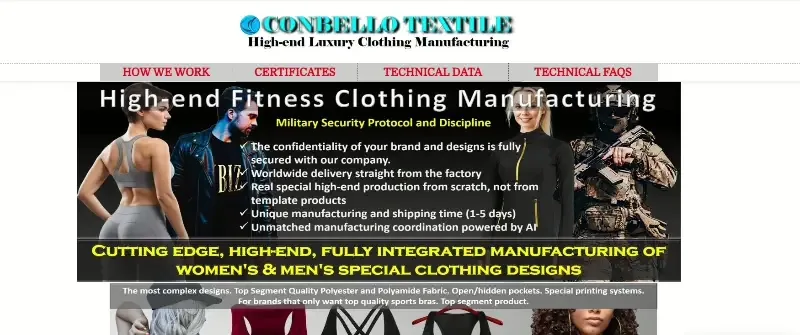
Most returns in the jacket business aren’t due to fabric—they happen because zippers jam or snaps rust. Conbello Textile positions itself as one of the best jacket manufacturers in Turkey for brands that need strict control over these critical “finishing touches.”
Instead of forcing you to coordinate with multiple trim suppliers, Conbello manages the entire Bill of Materials (BOM). I’ve found they excel at executing complex customization, from custom-molded zipper pulls to rubberized logo patches and branded linings. Unlike standard sewing floors, they reinforce pocket corners and stress-test hardware before assembly, ensuring the garment survives real-world wear.
Fit Check: Best for D2C brands and boutique drops focused on the unboxing experience and long-term durability.
- Pros: Deeply integrated accessory sourcing (woven labels, hangtags); rigorous QC on metal plating to prevent corrosion.
- Cons: Developing custom hardware molds typically pushes sampling timelines back by 10–15 days.
🛡️ Production Safeguard: Copy and paste these into your inquiry to vet hardware quality:
- Brand: Do you use YKK, SBS, or generic private molds?
- Corrosion: Do your metal snaps pass ISO 9227 salt spray testing?
- Logistics: Can you vacuum pack bulky puffers to reduce dimensional weight by 30%?
3. Kledingproductie
“Low MOQ” is often a trap in jacket manufacturing. Unlike single-layer T-shirts, outerwear involves complex supply chains—zippers, specialized dyeing, and insulation ratios. Usually, this complexity pushes minimums to 500+ units per style.
Kledingproductie is the exception. They function more like a high-end sample room than a mass production line, allowing pilot runs under 200 units.
I recommend them specifically for early-stage brands testing 1–2 styles. In my experience, you will pay a premium on unit cost—often 20–30% higher than bulk factories—but this protects you from the greater risk: sitting on 3,000 yards of deadstock fabric if the fit fails.
- Pros: Genuine small-batch flexibility; handles complex techwear construction.
- Cons: Slower lead times due to fragmented material sourcing; higher per-unit pricing.
Actionable Insight: Factories often ignore vague low-volume inquiries. To get a serious response, you must prove you are ready to produce. Attach these four items to your first email:
- Tech Pack: Full dimensional specs, not just a sketch.
- Detailed BOM: Specify the exact shell (e.g., Nylon 66), lining, and insulation weight.
- Volume Breakdowns: “50 Black, 50 Navy” is clearer than “100 total.”
- Compliance: Explicitly state if you need GRS (Global Recycled Standard) documentation.
4. Last Textile
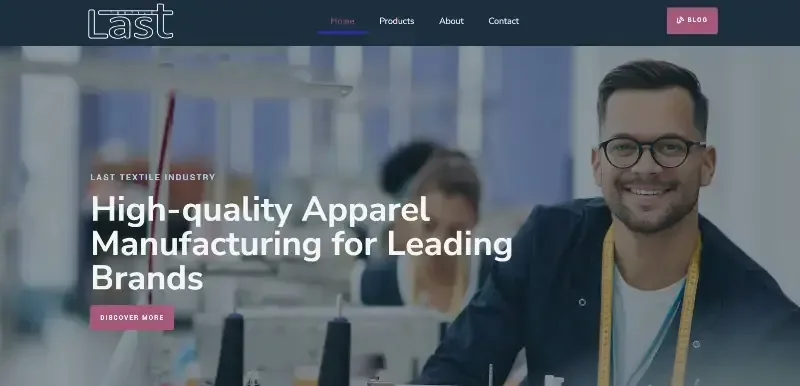
I often recommend Last Textile to buyers who need speed over total exclusivity. Their model bridges the gap between buying wholesale blanks and full custom manufacturing.
You start with their “Open Design” catalog. Pick a proven silhouette—like a standard 3-panel hood puffer—and add your branding to launch in weeks. Once you prove demand, you transition that same SKU into a fully custom production run. This strategy protects your cash flow during the validation phase.
Fit Check: Best for boutiques and marketplace sellers.
- Pros: Fast turnaround (often 3 weeks for private labeling). You avoid the risk of unproven fits.
- Cons: You must use stock fabrics for quick orders. Custom Pantone nylon triples the lead time.
⚠️ Customization Reality Check: Before you wire money, ask these three questions to ensure you can scale:
- The Fabric Trigger: “Does changing insulation from 200gsm to 300gsm trigger a new MOQ?” In my experience, this often jumps to 500+ units.
- Pattern Limits: “Can I change the quilt design (e.g., diamond to horizontal) without paying for new machine templates?”
- Tech Pack Utility: “If I move to full custom later, can you grade sizes based on the stock jacket I am buying now?”
🚀 Expert Take: Do not customize the fabric on your first order. Use their stock matte nylon in black or navy to test the fit and market demand first.
5. Sareteks
Sustainability claims are higher-stakes for outerwear than basic apparel. A jacket involves complex inputs—synthetic fills, animal down, and chemically tanned leathers—where one slip-up with non-compliant dyes can trigger customs seizures or lawsuits. Sareteks distinguishes itself by validating its supply chain, offering the concrete audit trails required by strict EU markets.
Fit Check: This manufacturer is best for brands that must document materials to back up marketing claims.
- Pros: They hold legitimate GRS (Global Recycled Standard) certifications for recycled polyester shells and fills.
- Cons: Certified materials typically add a 10–15% cost premium compared to standard inputs.
🛡️ Our Verdict: Don’t just ask if a factory is sustainable; ask for the paperwork. I always require these specific certificate IDs before issuing a purchase order to avoid greenwashing liability:
- Synthetics: Request the GRS Scope Certificate for the specific fabric roll, not just the facility.
- Safety: Ask for a current OEKO-TEX Standard 100 report (always check the expiry date).
- Animal Inputs: For down or leather, demand RDS (Responsible Down Standard) or LWG (Leather Working Group) audit numbers.
6. Kozanteks Textile
Most jacket returns stem from zipper failure or blown pocket bags, not fabric quality. Kozanteks prevents this through structural engineering.
I found they standardize reinforcements that cheaper factories skip. They apply fused interlining to pocket welts and use heavy-duty bartacks at high-stress zones like armholes and zipper bases. This prevents the seam slippage common in standard puffer jackets.
Fit Check: Kozanteks is the right partner for workwear brands and high-use uniform programs. If your business model cannot survive a 1-star review for a ripped seam, pay the premium here.
- Pros: Specialized heavy-gauge machinery for consistent double-needle topstitching.
- Cons: Production takes longer. Labor costs are ~15% higher than fast-fashion lines.
🛡️ The Durability Test Pack: Don’t just trust the sample. I require factories to pass this specific checklist before shipment. Add these to your QC contract:
- Zipper Fatigue: Mandate a 500-cycle up/down test to check for teeth misalignment.
- Seam Strength: Apply 15kg of tension to armhole seams to test for thread breakage.
- Abrasion: Request an ISO 12945-2 Martindale test (2,000 rubs) on shell fabrics.
- Inspection: Enforce AQL 2.5 standards specifically for loose threads inside the lining.
7. Desbina Textile
Generic factories often ruin streetwear drops by forcing standard sizing charts onto oversized designs. In my experience, Desbina Textile understands that a “cropped bomber” requires specific volume adjustments, not just a shorter hem. I found they excel at high-complexity capsules that generic plants refuse: varsity styles with heavy ribbing, dropped shoulders, and jackets with statement linings. When I reviewed their recent samples, the chenille patches were centered perfectly across the split zipper—a detail most volume factories miss.
They are the best fit for design-led brands prioritizing silhouette over speed.
- Pros: They execute complex construction details like welt pockets and diamond quilting patterns without simplifying your design intent.
- Cons: Achieving the perfect fit often requires 3–4 sample iterations. They tend to ask detailed questions during the tech pack review process, which extends development time but prevents production errors.
🔥 Tech Pack Protocol: To ensure fashion-forward fits scale correctly, copy these questions into your spec sheet:
- Grading Rules: “How do you grade shoulder drops for XL/XXL? We must maintain the boxy shape, not just widen it.”
- Tolerance Targets: “Can you guarantee ASTM standard tolerances of +/- 0.5cm for cropped lengths?”
- Ribbing: “Do you source heavy-weight (800GSM+) ribbing, or must we supply it?”
8. istanbulclothingmanufacturers
IstanbulClothingManufacturers operates as a sourcing gateway rather than a standalone factory. Cold emailing Turkish suppliers often results in silence; this collective solves that by connecting you directly to available production capacity across Istanbul. I recommend this path for procurement teams that need to gather multiple quotes quickly without vetting dozens of individual websites.
Fit Check: Use this platform to speed up supplier discovery. It allows you to compare costs between specific verticals—like a high-end denim specialist versus a generalist outerwear facility—in days rather than weeks.
- Pros: Drastically cuts research time. You get introductions to workshops that often lack a digital presence.
- Cons: It adds a middle layer. This obscures the supply chain and complicates quality control if you don’t verify the actual production site.
🛡️ The Transparency Test: “Who Sews It?” You might not know who is actually cutting your fabric. To mitigate this, ask these three questions before paying a deposit:
- Location: “Please send the pinned GPS location of the sewing floor, not the showroom.”
- Verification: “Can you send a live WhatsApp video of the production line running similar jackets?”
- Paperwork: “Who is the exporter of record on the customs invoice—you or the factory?”
Your Jacket Sourcing Action Plan: From Sketch to Shipment
You cannot source outerwear the same way you source t-shirts. The stakes are higher. A single error in insulation weight or zipper quality makes the entire garment unsellable. Follow this checklist to close the gap between a design concept and a finished product.
Step 1: Define Jacket Type and BOM First
Define your specific category immediately. Are you producing a technical custom bomber jacket with complex ribbing? Or are you sourcing heavy custom leather jackets that require specialized cutting tables?
Create a Bill of Materials (BOM) before you ask for a quote. List every component:
- Shell: Nylon, polyester, or wool blend.
- Lining: Taffeta, fleece, or mesh.
- Insulation: Down fill power or synthetic GSM.
- Trims: Zipper gauge (e.g., YKK #5), snap buttons, and drawcords.
Author’s Verdict: In our experience, vague BOMs cause the most pricing errors. If you do not specify the zipper brand, factories will use the cheapest option. It will break.
Step 2: Confirm Technical Capability
Do not trust a website portfolio alone. Request raw video footage of the production floor. Verify the equipment matches your product. Leather requires heavy-duty walking foot machines to prevent puckering. Puffers require specific quilting templates to ensure even fill distribution.
Ask for this “Minimum Evidence” checklist:
- Photos of inside seams (binding vs. overlock).
- Close-ups of zipper installation to check for waviness.
- Pocket construction details like bar-tack reinforcements.
Step 3: Get Hard Numbers on MOQs
Factories often give vague answers. You need specific numbers. Ask for the MOQ per style, color, and size run. Request a clear timeline for prototype development and sample revisions. Ask exactly what drives the MOQ up. Custom hardware or Pantone fabric dyeing often forces higher minimums.
- Sourcing Note: If Turkey’s minimums are too high, compare them against jacket manufacturers in China or agile clothing manufacturers in Shenzhen.
- Niche Alternatives: Consider Japanese clothing manufacturers for premium denim. Check the Ludhiana clothing manufacturers cluster in India for winter woolens.
Step 4: Verify Compliance and Sustainability
Outerwear faces strict customs scrutiny. Do not accept a verbal “yes” on sustainability. Request valid certificate copies like Standard 100 by OEKO-TEX for chemical safety or GRS for recycled plastics. If you use down, demand the Responsible Down Standard (RDS). Verify the license number directly on the issuer’s official website.
Step 5: Calculate Landed Cost and Shipping
Jackets are bulky. Shipping “air” kills your profit margin. Ask the factory if they offer vacuum packing for puffer styles. We found this often reduces carton volume by 30% or more.
Confirm your Incoterms (FOB vs. EXW) to understand who pays for freight. Discuss SKU-level HS codes with your broker early. Incorrect codes for animal materials like leather often lead to weeks of customs delays.
Ready to start? Avoid the logistics headache. Contact our team to secure your production line today.
FAQs About Jacket Manufacturer Turkey
1. What is a realistic MOQ for custom jackets in Turkey?
For custom puffer jackets, realistic Minimum Order Quantities (MOQs) start at 300 units per color. This is higher than T-shirts because outerwear requires complex line setups for zippers and linings. However, for leather jackets, we often see lower MOQs of 50 to 100 units due to the high material cost.
2. What should I send to get an accurate quote fast?
Factories ignore vague emails. To get a quote within 48 hours, attach a Mini Tech Pack. This must include a reference photo, a Bill of Materials (BOM) listing your fabric preference (e.g., Nylon 66), and your target quantity breakdown.
3. How do I verify RDS, LWG, or GRS claims?
Never trust a static PDF file. Ask the supplier for their Scope Certificate Number and the name of the certifier. Verify this number directly on the Textile Exchange or Leather Working Group public database. The company name in the database must match the factory name on your invoice. If they claim to use a “partner’s certificate,” you cannot legally market your goods as certified.
